The Witches Tools of Air & Water
A look at altar tools associated with the Elements of Air and Fire.
WITCHCRAFTBASICSWITCHCRAFTALTARSTOOLSMELISSA
Melissa Wittmann
9/12/2023
Building your collection of the tools of a witch can be great fun. There are tools out there for every budget and aesthetic. Go on the web for a little and look up images people have posted of their altars, and you will see those altars, and the tools on them, are as varied as the witch. Some people use different style altars for different purposes. For example, a coven’s ritual altar may be a lot more elaborate than the altar of a solitary kitchen witch. Is one more powerful than the other? No, probably not. Will one win the favor of the gods faster if that is the goal? Nope, not in my experience.
Tools are fun and serve a purpose in your magic. Spells can be cast, and rituals performed with no tools at all, but tools give you something to focus on and a place to direct your energy. They aid you in focusing and building your energy. In coven situations, altar tools focus and gather the group’s energy and combines it. Tools are aids.
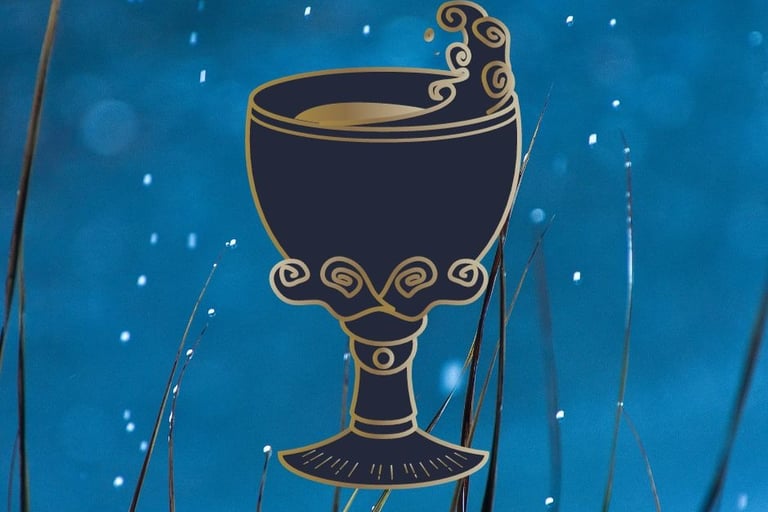
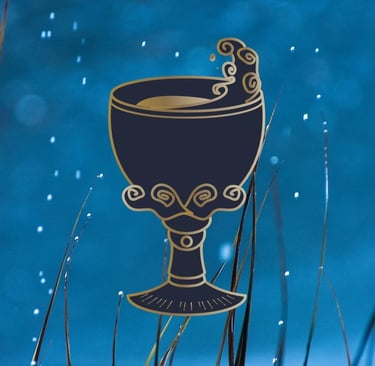
We’ve all seen pictures of the priestess holding a fancy cup up to the lips of the priest as he takes a sip of wine. That cup she is holding is a chalice or goblet. Traditionalists and Ceremonials use a chalice made from silver, but it can be made of anything you want as long as if you are drinking out of your chalice, it is food safe. A chalice is most often used to hold the “wine” consumed in ritual. The word chalice evolved from the Ancient Roman Latin word “calix” and was originally a bowl with a stand attached. I believe there is an old play or poem that contains the line, “fetch me my bowl,” it means fetch me my chalice. The chalice is also said to represent the womb of the Goddess and thus is said to have a more feminine energy.
Chalices have been a part of religious services and rituals for a very long time. But this sacred cup has more uses than just being a fancy drinking glass. A chalice can also hold holy water mixed with salt to purify the sacred space and represent the element of water. It can be used to collect water from a stream, sacred well, or even as it rains. You can make moon or sun water in a chalice. Fill the chalice with a dark wine or dark liquid and it can be a scrying vessel. Some covens have two chalices that they use, one for consumables and one for things you should not consume, like potions, incense, or things that are poisonous to humans. If you lack a cauldron, a fire=proof chalice can be used to burn incense, spell components, and paper petitions.
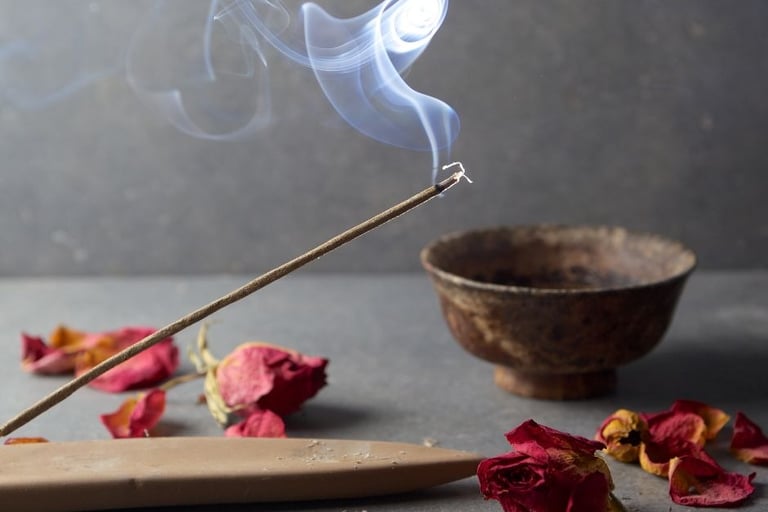
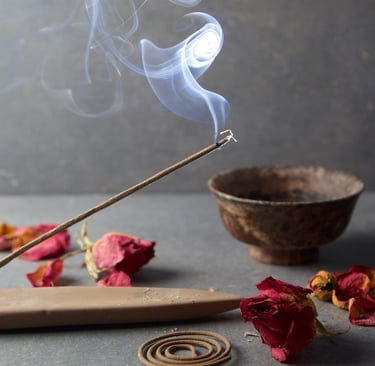
Next, we will be discussing incense. Incense is a blend of oils, resins, and powdered burnable materials that when burnt produce smoke and scent. It is one of the oldest and most universal items in the world. The word incense comes from the Ancient Roman Latin word for “ to burn”, “incendere” but incense is older than the Ancient Romans. The Ancient Egyptians would burn combustible dried flowers ritually and at home. In addition to being offerings to the gods, incense was burnt at home to dispel bad odors and cleanse the energy of a place. It was believed that the smell of burning incense warded against demons’ intent on mischief or harm. Some of the earliest know incense was created in the form of little balls by the Prehistoric Egyptians and the earliest known incense burner was from the 24thCentury BCE.
Incense use spread from Babylon into Ancient Greece and Roman. The Indus Civilization used oils for their smell and were the first to use dried roots and tubers in their incense sometime between 3300-1300 BCE. The invention of incense seems to have happened in several locations in the world at the same time. The oldest text mentioning incense is found in the Vedas from what is now modern day India. The Vedas mention burning incense for its pleasing smell and its medicinal properties. Incense became a tool for the religious practices of Hinduism and Buddhism from the very start.
Around 200 CE, wandering Buddhist monks introduced not only their religion, but also the incense stick to China. The Chinese had had incense from as far back as 2000 BCE and had used it in their religious practices. Use of incense in China is believed to go back as far as Neolithic China, but the earliest documented use was an incense composed to cassia, cinnamon, styrax, and sandalwood. During the Song Dynasty (960-1279 CE) entire buildings were built for the sole purpose of religious ceremonies involving the burning of incense. Another common name for the trade network known as the Silk Road was the Incense Road.
There are two types of incense, direct burning and indirect burning. Direct burning incense can be held to a flame and will smolder without the use of something like a charcoal brick. Indirect incense needs a constant heat source to smolder.
Incense in on the altar can be burned in a stick holder (a long narrow tray that holds one end of the stick and catches the ash as the incense burns.), a cauldron, a censer, or a thurible (a metal censer suspended from chains). Different cultures have different styles of burners. In modern times, incense can vary in price from very cheap to very expensive depending on quality, ingredients, and production methods.
Modern practitioners use incense as a representative of the element of Air, to cleanse the energy and sanctify the ritual space, to set the mood, carry spells and prayers on it’s smoke to the Universe, meditation, as an offering to a plethora of beings, aesthetics, and divination. In outdoor rituals, it can also be used as an insect repellent.
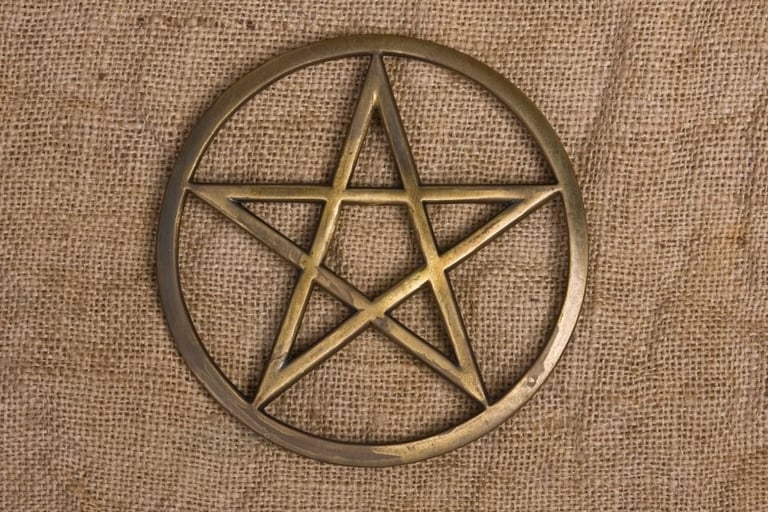
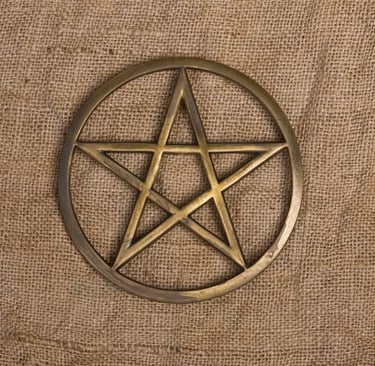
A Pentacle is a five-pointed star enclosed in a circle. It is one of the most common symbols in witchcraft and paganism. Depending on who you ask, it can represent anything from pure evil (generally no), man’s place in harmony with the Universe, Mind over the material, all the elements and Spirit working together, and Universal harmony.
It is often placed at the center of the altar or in some traditions, drawn on the floor beneath the altar. You will frequently see the pentacle on the altar inscribed onto a disc of some sort. This disc is referred to as a paten in Ceremonial, Traditional, etc. Traditions. Depending on whose altar it is on, there may also be sigils and runes inscribed with the pentacle. It is a place of focus when casting spells and is used to protect the ritual circle from malevolent energies. Most often it is used to call forth energies and to consecrate the sacred space.
The pentacle or paten can bear any holy symbol deemed to represent the workings or practice of the alter owner. It can be a circle of runes, a faery star, a sigil, or one of the seals of Solomon. Ceremonialists, Hermetics, and traditionalists tend to stick with the pentacle. The material of the pentacle can be whatever is available, fits the practice of, or fits the aesthetic of. Many traditional covens prefer a pentacle made of metal. Some creative pentacles include trivets bearing the Texas Star, sand-dollars, coins, and even an apple cut horizontally. Pentacles often represent the element of Earth.
Contrary to what some religious individuals may tell you, there is nothing inherently evil about the pentacle. Early popes and Christians used the pentacle as a symbol of God protecting man or God’s love encircling man. It wasn’t until later times that pentacles became a symbol of evil. Gardenarians and some British Traditional covens used an inverted pentacle as a symbol of their Second Degree. About the 1700’s is when people began using inverted pentacles to scare and upset religious people and modern satanists are happy to continue that tradition.
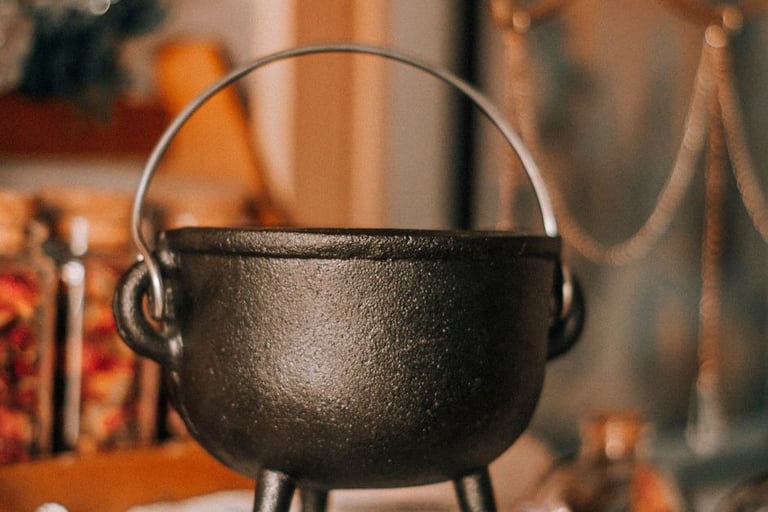
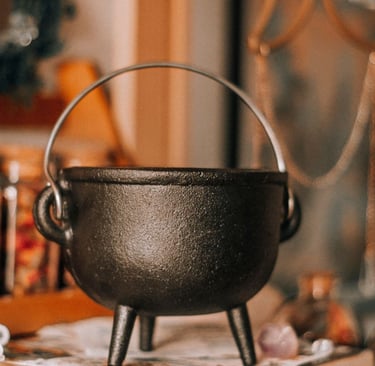
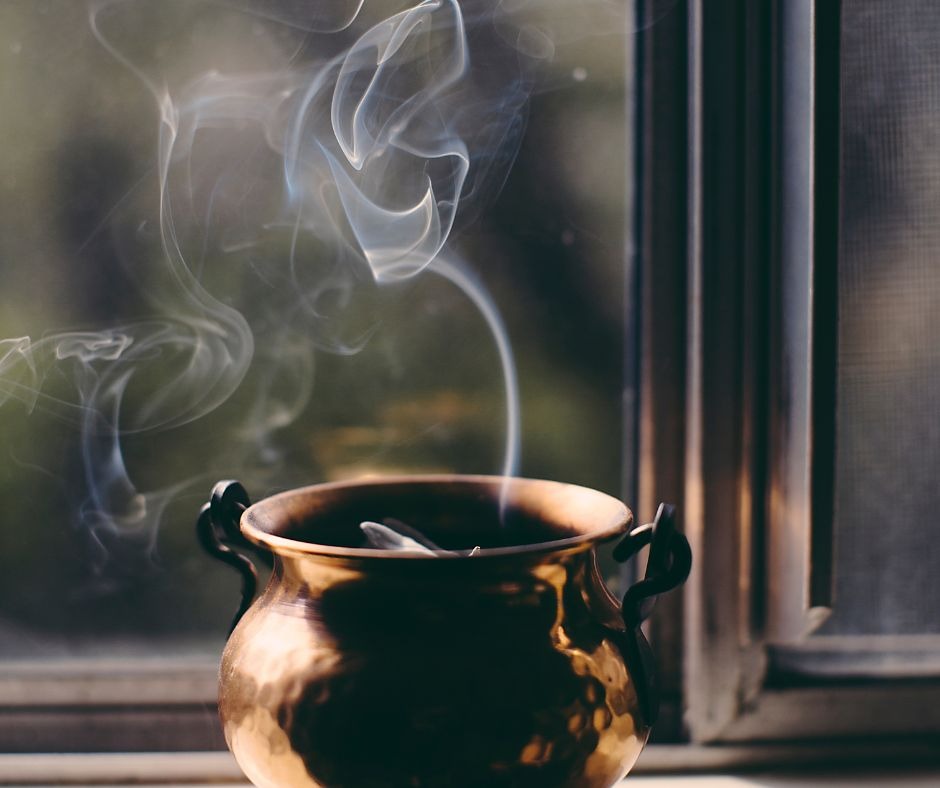
The last thing about the altar I am going to discuss is the cauldron. The image is everywhere of a witch or witches stirring some steaming cauldron casting spells. That image is founded somewhat in truth. Witches do use cauldrons, but so did almost everyone else in history. A cauldron traditionally was a pot that was used over an open flame or on a hot stove. The word cauldron goes back to that classical Latin word “caldarium” meaning hot bath and during the Norman invasion it replaced the Old English word “cetel.” Yes, a cauldron is also a kettle.
They were probably developed around the same time humans developed cooking. The oldest cauldrons that have been found come from the late Bronze Age (3300 to 1200 BCE). Like today, they range in size from small to very large. They were the ultimate multipurpose vessel in the past, being used for cooking food and heating water. The importance of the cauldron in life is illustrated by how often they are mentioned in the myths and stories of the past.
Today, most witch’s cauldrons are made from cast iron, but any fireproof material can be used. Depending on what the cauldron is used for or what it represents will determine the element it represents. For example, if the cauldron represents the womb of the goddess, then it corresponds to the element of Earth, but if the cauldron represents the waters of life and holds water, it is associated with water. Finally, if stuff is burned in the cauldron, then it is associated with fire. Cauldrons are great multi-purpose ritual vessels. Potions can be brewed in them; petitions and incense can be burnt in them. They can be used as a scrying mirror with the addition of a little water. Some people even store their crystals in a cauldron because it looks nice.