
The Nine Muses: The Sisterhood of Divine Inspiration
In Ancient Greece, there existed nine sisters who inspired mankind. Learn a little about them and their legacy.
Melissa Wittmann
3/3/2025
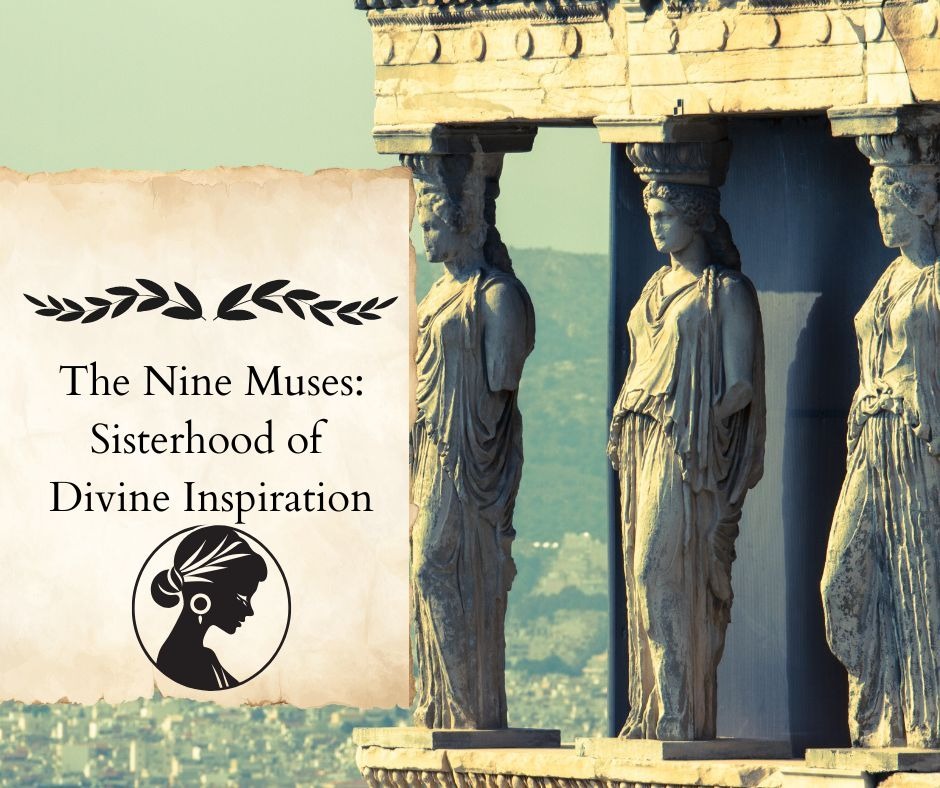
In many cultures and throughout time, inspiration was considered a divine gift granted from divine beings who seek out mortals worthy of that gift. To the Ancient Greeks, those divine beings were a group of beautiful sisters known as the Muses. Each Muse had a name and area of expertise that mortals could pray to for those gifts.
The stories and worship centers for the Muses began mainly in two separate regions of Anceint Greece, Thrace and Delphi. There were other smaller areas that had stories of the Muses during the Ancient Period, but most people have heard the stories from Thrace and Delphi. Central Greece is the location of a community called Boetia within a region known as Thrace. They were one of the earliest cities to establish a temple for the Muses. In people of Boetia honored three muses who were the daughters of Zeus and Mnemmone (the Titan Goddess of Memory). The three sisters were named Aoide (Muse of Songs or Tunes), Mneme (Muse of Memory) and Melete (the Muse of Practice or Occasions).
The Muses of Delphi were honored in the temple that would later become the Temple of Apollo. They had the names Nete, Mese, and Hypate. This set of Muses were focused on inspiration of music. Just a little trivia, it is believed that the lyre came from the region of Delphi and each Muse’s name corresponds to a chord on the lyre.
In Hesiod’s 7th Century BCE work, Theogany, the Muses were the daughter of Zeus and Mnemosyne. Because of their mother, the Muses had, according to Hesiod, was the ability to bring a forgetfulness of pain and suffering, as well as bestowing an urge onto mortals to escape obligations.
Some ancient Greek Poets claimed that the muses were the daughters of primordial deities such as Uranus and Gaia. Different regions had developed different origin myths about the Muses, often linking them to Gods and Goddesses that were honored in that region
In true Ancient Greek divine tradition, the myths handed down are littered with the Muses setting up challenges with mortals. Also, true to the Ancient Greed Goddesses, when the mortals fail to win the challenges, they were brutally punished. For example, there was a singer in Thrace named Thamyris who challenged the Muses to a singing contest. He lost the contest and the Muses took his singing ability and, just for funsies, blinded him. Ancient Greek Idol was brutal and it doesn’t stop there. In Metamorphases by Ovid, he tells of the Muses going up agains the 9 daughters of Pierus of Macadon. King Pierus loved his daughters and even named them after the Nine Muses. The daughters lost whatever challenge was set up and the Muses turned the daughts into chattering jays.
So who are those delightful daughters of Zeus and Mnemmone? Now, we think of the Muses as a group of Nine sisters that had worship centers in Delphi and Boetia, with other minor temples spread out throughout the country.
I’m going to go over the names of the Muses and that their sprecialty was and starting next week, we will be going over each Muse in more detail.
1. Calliope is the Muse associated with eloquence and epic poetry.
2. Clio I the Muse of History and the Lyre
3. Erato- Muse of Lyric and Erotic Poetry
4. Polyhymnia- is the Muse of Lyric Poetry, Geometry, Dance, and Retoric. She also is involved in developing the lyre, agriculture, and musical harmony
5. Euterpe is the Muse of music and lyric poetry. Also, she is credited with creating the flute and is known as the giver of joy.
6. Terpsichore is the Muse of light verse and dance. She is also the muse of the Chorus.
7. Melpomene is the Muse of Tragedy and chorus in Greek Theatre. The Tragedy Mask represents her.
8. Thalia is the Muse of Comedy and Idyllic poetry. The Comedy mask represents her.
9. Urania is the Ninth Muse and rules over astrology, the stars, and astronomy.