Samhain: The Festival and the Dead
Learn about the sabbat of Samhain.
WITCHCRAFTBASICSWITCHCRAFTSABBATSMELISSA
Melissa Wittmann
10/24/2023
One of my favorite times of the year is Halloween. Some of my favorite memories of my childhood involve dressing in costumes (don’t get me started on the plastic costumes and the masks you couldn’t see in), going trick or treating, and just the general spooky vibe of the holiday. I grew up in a house that decorated a lot and gave our full-size candy bars. My parents loved answering the door and seeing the little kids in costumes. Even when I became a witch, Halloween was my favorite time of the year. As an adult witch, my favorite part of the holiday is the honoring my ancestors. But where did this holiday come from? And how did it become this mix of joyful and somber?
Samhain (pronounced Sow-wen) began during a time when things were much harder and much more agricultural. It is a mainly Gaelic festival, but the non-Gaelic cultures also had similar festivals around the same time and on the same themes. This is the third Harvest festival of the Wiccan Wheel of the Year. What crops weren’t harvested by this time were most likely destroyed by the frosts that occur in the late Autumn. Before the time of grocery stores and pizza delivery, it was important to get as much food harvested as possible before it got ruined by the frosts. It was a matter of life and death to have enough food for the months when food would not grow. There is even a Celtic belief that any crops in the fields after Samhain are the property of the Faery folk and should be left in the fields.
There is some evidence that the holiday was significant to the earliest Gauls and Celts. Neolithic tombs in the British Isles sometimes would contain passages that lighted up with the sunrise on Samhain and the sun would illuminate the back of the otherwise dark tomb. Neolithic peoples did not align their passage tomb to the sunrise of just any day of the year unless that day was significant. The myths of the ancient Irish people feature feasts, festivals, and even human sacrifice for the holiday. Samhain was also considered a liminal or threshold festival where the veil of boundary between the worlds was thinnest and passage between the realms of Faery, human, and the dead could be crossed.
Because that boundary could easily be crossed, people took precautions in the forms of leaving offerings to appease the spirits from the other side, wearing masks to hid your identity, and carving turnips into faces that then has a candle lit inside to scare away malevolent spirits became traditions that we utilize today to celebrate the holiday.
Mumming, or guising, was done as a part of the fun for the holiday. People would dress in disguise and go door-to-door in their village. Often songs or poems were given in exchange for food or drink. It was believed that since you never knew if the person in the costume was a living human or an otherworld being, the best course of action was to give them food as an offering for protection from harm. These traditions can be seen in modern times in the form of trick-or-treat. The once all ages tradition has become a kids only (and maybe a few college age kids) Halloween tradition.
Mumming has also evolved and still exist today. Groups of mummers will still dress up and perform plays and sing songs for food and drink in parts of the British Isles and on New Year’s Day in Philadelphia, Pennsylvania Mummers hold a big parade full of elaborate costumes.
The lands of the Gauls and Celts did not have pumpkins to make scary jack-o-lanterns from. Our ancestors would carve turnips and light them with a candle inside. It is said that their little lights were inspired by “foolish fire” or the will-o’-the ‘wisps for legend. The jack-o-lantern was originally a form of protection charm. It was used to scare away spirits intent on causing mischief and harm. The origin story comes from the Irish legend about a man named Stringy Jack who made a deal with Satan and is doomed to wander the earth with a light in a hollowed our turnip as his only light at night. The tradition of carving turnips is far older than the Christian caution tale that is Stringy Jack. When the Celtic people emigrated to the New world starting in the 1600’s, they brought their root vegetable carving tradition with them and traded in their hard turnips for the easier to carve pumpkin.
Another big part of the holiday is performing divinations. Unless you hang out with pagans and witches, this isn’t done as much anymore as it was in the past. One of the oldest traditional divinations for Samhain is bobbing for apples. There are two methods of this that can be used. The first method is apples were hung on strings and people would try to catch a swinging apple with their teeth and then the apple was peeled in one long peel while the person peeling would recite the alphabet. The letter that the person says when the peel breaks is the first letter of the name of their future spouse. The second method is the bucket of water method. All the single guys in the community would be assigned an apple and those apples would be floating in a big bucket of water, the maidens in the village would dunk their heads in the water and try to catch an apple. When the girl would catch an apple, again with her teeth, they would see whose apple they caught and that was believed to be their future spouse.
Charm cakes were another popular form of divination done in the past to celebrate the holiday. A treat would be made and the charm or charms would be hidden inside and whoever gets the charm while consuming the treat will be blessed, or cursed, with what the charm represents. Some examples of charms include a coin for good fortune, a bean for a bountiful harvest, a ring for a wedding, etc. Some traditions use different beans to represent different things. We still see charm cakes in the Southern United States for bridal showers and baby showers, as well as in King Cakes and Epiphany Cake.
In modern times, things like tarot cards and Ouija boards are used to perform divinations. And communicate with the spirits of the dead. Both divinations are also popular in modern horror movies set during the Halloween season.
In Ancient Greece, the mythology tells us that this time of year is when Kore leaves her mother, Demeter, for the Underworld and her husband, Hades. Demeter goes into mourning for her daughter and refuses to let anything grow during the time her daughter is away. While she is Queen of the Underworld, Kore is referred to as Persephone. When she returns in the Spring, Demeter will come out of mourning and things will begin to grow again.
In the Medieval Christian church, the feast of Samhain was called All Souls Day or All Saints Day. It was a time to honor the Saints of the Church, especially the saints that lacked calendar days and honor the Souls who have gone on to Heaven. It is a time when people would tidy the graves of loved one and lay the last flowers on the grave until Springtime. In some areas, it was traditional to sit by the grave for the night to make sure nothing destroys the grave and interrupts the rest of the person in the grave.
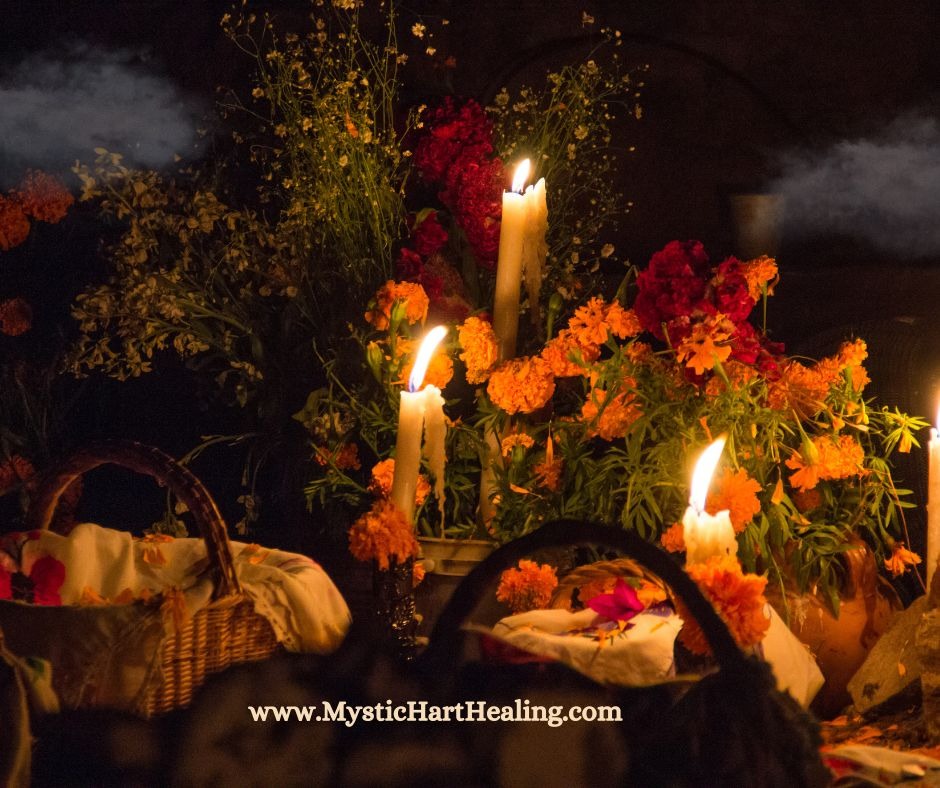
Mexico probably has the second most famous holiday celebrated this time of the year, Dia de los Muertos or the Day of the Dead. It has been described as a joyful celebration of mourning and remembrance. Altars are set up in the home adorned with pictures of relatives that have died, favorite foods, marigold flowers, and trinkets from the dead. The souls of the deceased are encouraged to join the festivities. Another big part of this festival is traveling to the cemetery to decorating the graves and celebrate the holiday with the deceased.
As a Pagan, I love this sabbat. The joyous celebration of the harvest paired with the somber remembrance of those who lived before me just strikes a chord. There is a time to laugh and a time to cry, but sometimes there is a need to do both at once. Appreciate what you have worked for and remember what is behind you. Raise a glass of cider to your ancestors and, remember, fun size candy bars are acceptable offerings.