Playing with Dolls: The History and Lore of Poppets
Dolls have been used in magic for ages. Learn a little about poppet magic from around the world.
TOOLSHISTORYWITCHCRAFTWITCHCRAFTBASICSMELISSA
Melissa Wittmann
5/17/2026
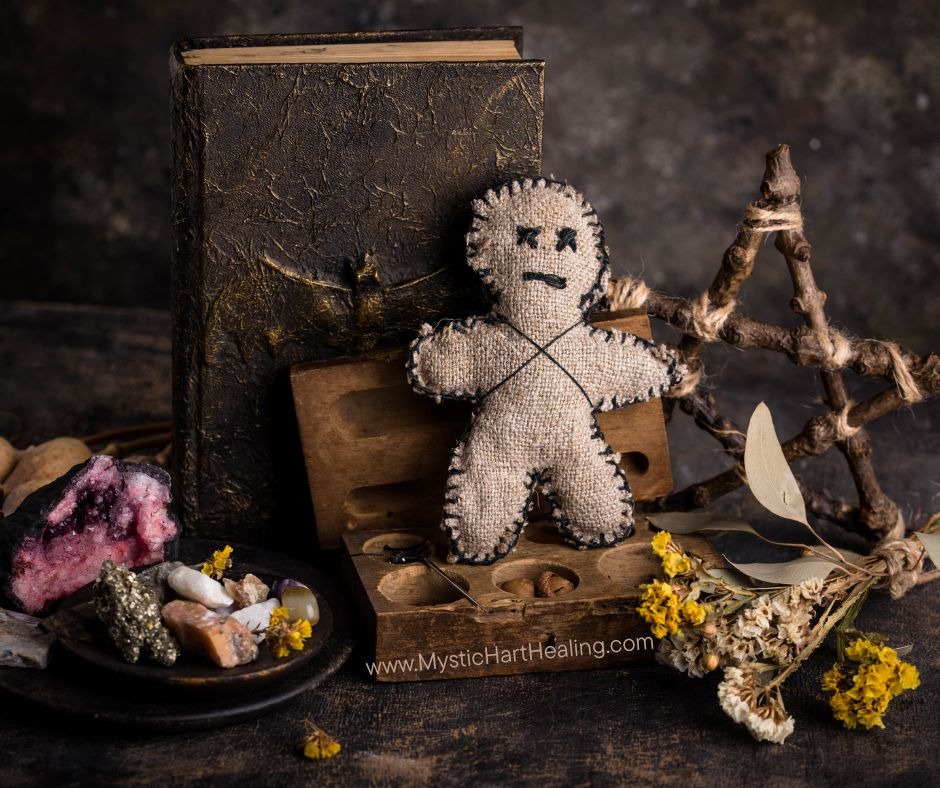
A poppet is a doll or figurine made to represent a person, goal, or group of people as an aid for casting spells. Poppets don’t need to be just people, animal poppets are also a thing, too. They are used to focus the caster’s energy on while the caster performs spells to affect the focus of the spell. Poppets have a lot of uses in magic and are widely popular in modern magic.
Magically, a little doll shaped like a person may not seem very powerful and more like playing with dolls than casting spells. That little doll represents the target of the spell whether it be the caster or someone else. They are a tool to allow you to focus the energy. In the case of some spells, the focus of the spell cannot be logistically at the location of the spell.
Currently and throughout history, poppets have been useful in many types of rituals and spells often when the subject of the spell cannot be at the location where the spell or ritual is being performed. Magically, a poppet can be used in many types of spells, including spells for healing, pain relief, protection, lessening fear, prosperity, love spells, friendship spells, and spells to help someone find a new job. Poppets can also be used in baneful magic and curses, as well as spells to bind someone or bring them bad luck. Most non-witches when they hear of poppets think of curses, but a poppet can do so much more than cause pain through the use of carefully placed pins in a little doll.
Sympathetic Magic
Poppet magic works with one of the oldest forms of magic practiced, sympathetic magic. This is a type of magic that works by casting a spell on something that represents the focus of the spell. Say you are casting a protection spell on your dog while he is at the kennel so you can take a trip. You can use a little doll to represent your dog when casting your spell. To protect him, you can wrap his poppet in a blanket for comfort and then wrap them in bubble wrap to protect them from any harm. Every action you take in your spell with the poppet will manifest as the actual idea for your dog. Because poppets can be small and portable, you can also being that poppet with you and use it to send you dog love and ear scritches as needed.
Taglocks
It’s common superstition that you don’t leave stands of hair or fingernails just laying around. The superstition states that hair and fingernails can be used to cast a hex on you. Those items contain your DNA and it can be used to tie magic to you. Poppets can be made as realistic as you wish when you are working your magic with them, however, if you want to give your poppet a little extra connection, add some DNA to the poppet. This is called a taglock. DNA taglocks can include hair, nail clippings (finger and toe), spit, blood, other bodily fluids, and anything that may contain the subject of the spells DNA. Please note, DNA can be used in healing, protection, and prosperity spells, it’s not just for curses or hexes.
If you can’t get someone’s DNA, there are other things that can be used as a taglock. Names are very powerful and create a strong connection between the poppet and the subject. If you don’t have access to a person’s full, legal name, you can use nicknames or partial names. Just write the name on a piece of paper or parchment paper and visualize a connection between that name and the person the poppet is for. Drawings or photographs of the subject are also valid taglocks. Written descriptions of the person, details about the person, or why you want the spell worked on them can be taglocks. Other common taglocks can include something they owned (can be a small scrap, it doesn’t need to be the whole thing), bits of their clothing, or anything that can be used to represent them.
Older than You Think
The use of poppets in magic is old, possibly Paleolithic old. Sadly, we may never know if our pre-historic ancestors used poppets in magic, but I believe they practiced sympathetic magic and quite possibly poppet magic. We just don’t have proof of it.
We do, however, know that the Ancient Egyptians did practice poppet magic. The poppets used were often wax figurines. In approximately 1200 BCE, there was an attempt to assassinate Pharoh Ramses III lead by one of his wives, Tiye, plus several members of his own haram and a treasury official. They used a wax poppet to magically aid in the assassination, When Rames III’s body was found, it is said there were no marks on it but he was dead. Historians believe he may have been poisoned, but we are not sure. The assignation was written about and is one of the oldest written accounts of the use of poppets. A murder most foul on the shores of the Nile.
The Ancient Greeks utilized kolossoi, poppet dolls. The kolossoi were used magically in everything from love spells to bind two lovers together to protection spells that bound dangerous ghosts and minor deities into a doll to protect people and property. We have written spells from this time that show the extensive use of poppets. In 270 BCE, playwright, Theocritus included a scene in one of his tragedies a character that is melting wax poppets to break a spell. There are several surviving wax poppets from Ancient Greece that still exist today and can be found in museums around the world.
Poppets of the World
West African Fetish Dolls
Found in West Africa, these dolls are believed to be possessed by spirits or, in some cases, represent the spirit of the doll’s owner. These dolls were often small and carried or worn by the owner as a form of amulet to keep the person safe and healthy. Larger fetish dolls used for protection were placed at village gates or in front of homes to protect the people inside. Fertility fetishes were often popular with women trying to conceive. Fetish dolls were made from what was available in the area, including local woods, bits of cloth, nails, shells, grasses, and herbs. The users believed they contained strong magic. During the 1700 and 1800s in North America, slave owners feared the power of the dolls so much, that being caught with a fetish would be a death sentence. Samples of West African fetish dolls can be found in museums and images can be looked at online.
Voodoo Dolls
Most people have seen Voodoo Dolls in movies or television shows. Those scary, little dolls that look like their victim, with pins stuck in them that cause pain and harm. They became popular in post-Civil War New Orleans, Louisiana. Practitioners credit the dolls with originating in Haiti, but historical records show them existing in New Orleans before they existed in Haiti. Originally, voodoo dolls were a small figurine made from two crossed sticks that were wrapped in fabric and other objects. These dolls were used to house the spirit of a deity or Iwa to gain their blessings or favor. They vary from being a simple, crude poppet to a work of art. They were not used to enact harm but rather bring healing, learning, and blessing.
The image of Voodoo dolls filled with pins designed to cause harm on an enemy is the fabrication of Hollywood and is meant to vilianify the Voodoo faith and its practitioners. In reality, the dolls were used as a point of focus during rituals and spell works and never were used to cause harm. The dolls are sacred objects and are respected as such. Real voodoo dolls are called wanga dolls or poupee. They are created for healing work, road opening, love magic, and protection.
They are an unofficial symbol of New Orleans Voodoo past and can be purchased all over the city. Many modern-day Voodoo and Hoodoo practitioners are trying to get away from the image that their faith is full of dark magic that uses voodoo dolls to harm or kill their enemies.
Kitchen Witch Dolls
Have you ever walked into someone’s kitchen and see a little witch doll hanging somewhere? That is a kitchen witch, and her job is to protect the kitchen. The use of kitchen witches originated in Scandinavia and Germany. They are believed to attract good energy into the home and prevent kitchen disaster. Currently, kitchen witches can take many forms and be found all over the world and in homes of many different faiths. Original kitchen witches were little old hag dolls that were hung somewhere discretely in the kitchen. One of my grandmothers had one hanging on the wall behind her stove and the other grandmother kept one hanging from the bottom of a Jesus painting she hung on her kitchen wall. If you are not the cloth doll type, kitchen witches can be found in the forms of salt and pepper shakers, small puppets with strings, little plaques. Images on canisters, grease pots, aprons, dishtowels, and wooden spoons. We are fortunate to have our kitchens protected with so many options.
Corn Dolly
They are a little dolly made from corn husks or grains woven to resemble a human figure, usually a woman. They date back into the early days of European history and are believed to have originated somewhere in Northern Europe. They were often used during harvest festivals. Corn is an old world in English that means grain, it was in use long before the North American crop of maize came to Europe and took on the name of corn.
The use of corn or grain dollies originated somewhere in Northern Europe. They were a harvest tradition where the last grain harvested was woven into a dolly used to honor the spirits of bounty. Once woven, the dolly would be taken inside the home and kept safe and warm until the fields are plowed in the spring. The corn dolly was laid in the first section of the field and plowed into the furrow thus planting the bounty of last year’s harvest into this year’s fields. With the conversion to Christianity and the mechanization of farming methods, the use of corn dollies vanished, except as a folk craft and superstition.
Corn husk dollies in North American come from Northeastern indigenous traditions that were adapted by early European settlers. Little dolls made from woven corn husks were common child toys in North America. European settlers learned to make these dolls and incorporated them into the folk magic they brought with them. In addition to being little dolls, the Europeans used them as charms to protect the home and livestock, ensure personal wellness, and to celebrate harvest holidays. The grain dolly of Europe easily became the corn husk dolly.
Corn husk dollies do not have faces according to Native legends. One of the Three Sisters, the Corn Maiden, fashioned a doll out of her corn husks to entertain children. The doll was given a face and rather than entertain the children, she spent all her time contemplating her beauty. The Corn Maiden was not impressed with the doll’s vanity and refusal to do its job, so she took the doll’s face away. Therefore, corn husk dollies are not given faces.
Hoko Dolls
Hoko dolls are soft-bodied dolls given in Japan to pregnant women as a form of protection for their unborn child. These little protection dolls are traditionally made from silk with cotton stuffing and, sometimes, real human hair. The dolls were a twin talisman for the child, with the goal being to confuse anything hoping to harm the child and intercept all bad luck. Once the baby was born, the doll was given to the baby to maintain protection. Around the age of 15, boys would give up their dolls at a shrine, thus taking control of their life and keeping themselves safe. Girls would give up their dolls when they married.
Hoko dolls are also known as “crawling baby” dolls because they often resemble a crawling baby in silk clothes. They are believed to have originated during the Edo period (1615-1868). They generally have a squarish body that also forms two arms and two legs. Heads could be anything roundish, simple heads are stuffed fabric with embroidered details and fancier heads were carved stone or wood. There are a lot of samples of this type of doll in museums that show Japanese artifacts and versions of them can be purchased or made today. The dolls for a male baby are often called Amagatsu dolls and dolls for girls were referred to as Hoko (Hoko is also the generic term for this type of doll.)
Montanka Dolls
These poppet dolls are used as amulets in areas of Poland, Ukraine, Belarus, and Russia. First mentions of this doll are found 5000 years ago in the Trypilian Culture. The name of the doll come from a word meaning “twisting,” because the fabric used for the doll is folded and twisted to form the doll. Piercing the doll with a sharp object, such as when sewing, is forbidden and considered bad luck. Montanka dolls do not have a face, instead they bear a woven cross that represents harmony in the world.
During life events of great significance, they were often gifted. During weddings and the birth of a child, the dolls are bringers of health, prosperity, and good fortune. If given to a family during a life changing or challenging time, they were protectors of misfortune and brought good luck. It is believed that the most powerful dolls were made by a mother for her child because they are infused with motherly love.
Montanka dolls are ritually made with forethought and positive thoughts. In the Ukraine, details such as material used, colors chosen, and even the mindset of the maker are all part of a tradition that gives the doll power and purpose. They are still made to this day and can be found in museums and even purchased. They were and are made to guard families, grant wishes, and bring prosperous marriages. This is one cultural tradition that started to fade out of use, but in recent years, they have been gaining in popularity as the Ukraine fights to remain independent.
Effigy
If you have ever seen pictures of Bonfire Night from England, there is a good chance that you saw an effigy of a man named Guy Fawkes. An effigy is a sculptural representations, often life-sized, of a person, real or allegorical. They are made to symbolically punish, murder, or curse because the actual person cannot be punished or killed. The subject of an effigy can be everyone from an unpopular political figure to criminals. In some cases, the effigy may be a representative of someone the maker knows but isn’t a famous person.
Effigies are and were sometimes used to represent people being cremated at a funeral. This was used mainly if the body of the deceased is missing or buried in another location. This is often done in cultures where creamation of the dead was vital to travel to the afterlife.
Worry or Trouble Dolls
These small, handmade dolls come from the indigenous populations of the highlands of Guatemala. They are tiny little dolls (1/2 inch to 2 inches tall) that are made from scraps of yarns, wire, thread, twigs, and cloth. The makers will dress the dolls in traditional Mayan costumes.
To use a worry doll, the user will tell the doll all their worries, secrets, and problems. Once the doll is told everything, they are placed under a pillow or outside window sill. During the night, they will tell the goddess everything they know and unburden the user.
Worry dolls are said to have begun with a Mayan princess named Ixmucane. The gods gave her a powerful gift to allow her to do her duty of solving any problem that a human was consumed with worry about. She began by giving the dolls to worried children with the directions to whisper their worries to the doll and thus relieve them of the stress they carried. At night, the children were told to place the dolls under their pillows. While the child slept, the doll would take the worries to Ixmucane and she would solve the worry.
These little dolls can be purchased from the local population in Guatemala or, if you are not near Guatemala, they can be purchased off the internet. They are still popular today. There are therapists that deal with traumatized children who use them to help the children deal with their trauma.
In closing…
This is only a small selection of the types of poppets used in the world. They are powerful tools for a witch to use but also must be used respectfully. Even though the theory is the same in most poppet use, poppet styles from closed practices should not be used unless you are part of that culture.
I love making and using poppets. There is something empowering about working with what looks like a simple, folky tool that packs a powerful punch. In the past, I’ve done workshops on making and using poppets and I hope to make a few videos on the use of poppets in magic.
Poppets are not all harmful curses, but there are more ways to use them without harm that most people realize. They can serve as protectors and guardians of you and your home. Poppets can be used as effigies for spells where the subject is unable to be with the witch, healing spells done on a poppet of someone injured can still aid in healing and give the caster a place to focus on. It’s okay to play with dolls and I encourage my witches out there to experiment with poppets in magic.