Ogham: The Alphabet of the Trees
Learn about the Pre-Christian alphabet from the British Isles.
DIVINATIONHISTORYWITCHCRAFTBASICSWITCHCRAFTOGHAMMELISSA
Melissa Wittmann
6/27/2023
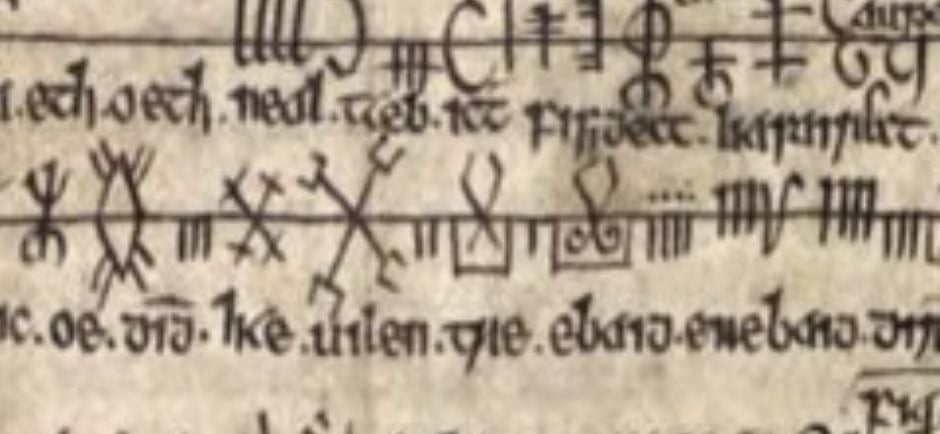
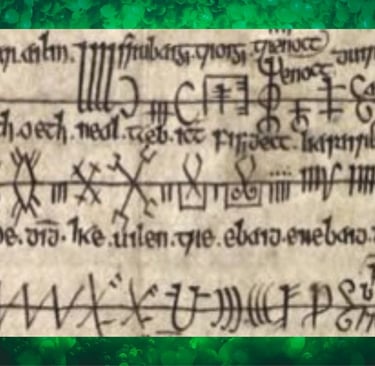
There is a script from the British Isles that looks like a cross between tally marks and runes. That script is called The Ogham. These inscriptions have been found in Ireland, Wales, Cornwall, and The Isle of Man. In Modern times, the letters of the Ogham have tree names linked to them and are used as a form of divination. Who created the alphabet and why it was created has become a matter of mystery and myth.
In pre-Christian Irish culture, things were not written down. It is believed that the scholar/religious class of the Irish, the Druids, believed that when things were written down, they would eventually be lost to the knowledge of the people. Instead, the Druids trained for many years to learn and memorized all the lore and laws of Irish culture. Other historians suggest that if the Druids did write stuff down it was written on materials that decayed and left no writings in the historical record. Things like bark, thin wood, hides, and fabric decay quickly in the environment of Ireland.
When the Romans came to the British Isles, it is believed that the Irish Druids encountered the Romans but the Roman had little influence on the Irish, if any. The first known document to be written in Ireland was accredited to Saint Patrick and was written in Latin and that was after 432 CE at the earliest. The earliest inscriptions in Ogham that we have date from around the 4th Century CE. Those inscriptions are written in Primitive Irish and the surviving carvings mainly represent names on memorial markers and marks that possibly indicate land ownership.
So, why was this alphabet created and when was it created? We really don’t know, and we really don’t know. Let’s start with the when was it created, the surviving examples of Ogham we have date back as far as the 4th Century CE and are all carved in stone. If the alphabet existed before then, we must assume that it was carved on items that have decayed to nothing. On theory suggests that the Irish knew of the Romans in England and Wales and, fearing an invasion, created a secret writing system that was only written on items that would decay in time. This system was designed to pass secret messages among communities and could easily be destroyed should the Romans invade. After the threat of Roman invasion was gone, they continued to use the alphabet, carved into stones now, to mark property lines and to denote graves and people of importance. The biggest problem with this theory is that there are stones in Wales that have been found with inscriptions that are in both Ogham and the Latin Alphabet.
Other theories include that the Early Irish Christians wanted their own alphabet that made it easier to transcribe Primitive Irish into the written word. Supposedly, Primitive Irish is hard to transcribe with the Latin Alphabet. Truth is, we don’t know why Ogham was created.
The how it was created is just as much of a mystery. Ogham letters have commonalities with the Latin Alphabet, Runes, and numeric tally marks, but we have no proof that any of these things had any part in the creation of the alphabet. According to Lebor Gabala Erenn, an 11th Century Scholar, the Ogham was invented shortly after the Fall of the Tower of Babel from the Bible. Meanwhile, an early Medieval book called the Ogam Tract credits a Gaelic god named Ogma, or Ogmios, with creating the Ogham alphabet as a means for the skilled to write speeches and poetry and denied it’s use to rustic people and fools.
We may never know for sure who created the Ogham, when it was created, or what inspired its creation, but we know that the natural world helped to define the names of the letters. The letters have had trees and plants sacred to the druids associated with them since the earliest records of the alphabet. One of the earliest nicknames of the Ogham was The Alphabet of the Trees. Sacred trees, such as the Oak, the Holly, the Elder, the Hazel, and plants like Vine and Reed have letters connected to them.
Originally, the Ogham was made up of 20 feda (letters) arranged into four aicmi (families). Five additional letters were added in later centuries, and they are referred to as the forfeda. These letters are written and read from the bottom to the top in inscriptions. Unlike most written alphabets, Ogham can be written horizontally or vertically. The alphabet was designed to be carved into wood or stone and not written with pen and ink.
Robert Graves discussed the ogham and his theories regarding it in his book The White Goddess. Graves posited that the alphabet had a stone age Middle Eastern origin and was tied to the worship of a Moon Goddess there. The alphabet came to the Celts through a sea-faring people during the 2nd Century BCE along with worship of this Moon Goddess. Though, largely discredited, Graves work was a major influence on the early Neo-Pagan movement and the ideas they established as part of neo-Paganism. Neo-Pagans also began to use the alphabet as a form of divination. Much of the idea of Ogham being a divination tool comes from a brief mention in the book Tochmarc Etaine or the Irish Mythological Cycle. There is a story in the book about a druid named Dalan who takes four yew sticks, carves the alphabet onto them, and does divination with them. The book does not explain how to do the divination, nor does it say what the various letters mean.
Like many things recreated and used in modern Neo-paganism, the Ogham of history is not exactly the Ogham we use today. The letters are the same, but the meanings have been reinvented for the most part. Much of the historic record on what was assigned meaning-wise is non-existent. With that being said, the Ogham as a divination tool is a very powerful tool for those who are drawn to it. It is a beautiful writing system and is very usable as such for decoration and for secret texts. Personally, I look forward to what archeological discoveries are made about Ogham in the future. With each new archaeological discovery comes new understanding regarding the beautiful Alphabet of the Trees.