It’s All in the Cards: The History of Tarot
A look into the history of Tarot.
DIVINATIONTAROTHISTORYWITCHCRAFTWITCHCRAFTBASICSMELISSA
Melissa Wittmann
5/22/2023
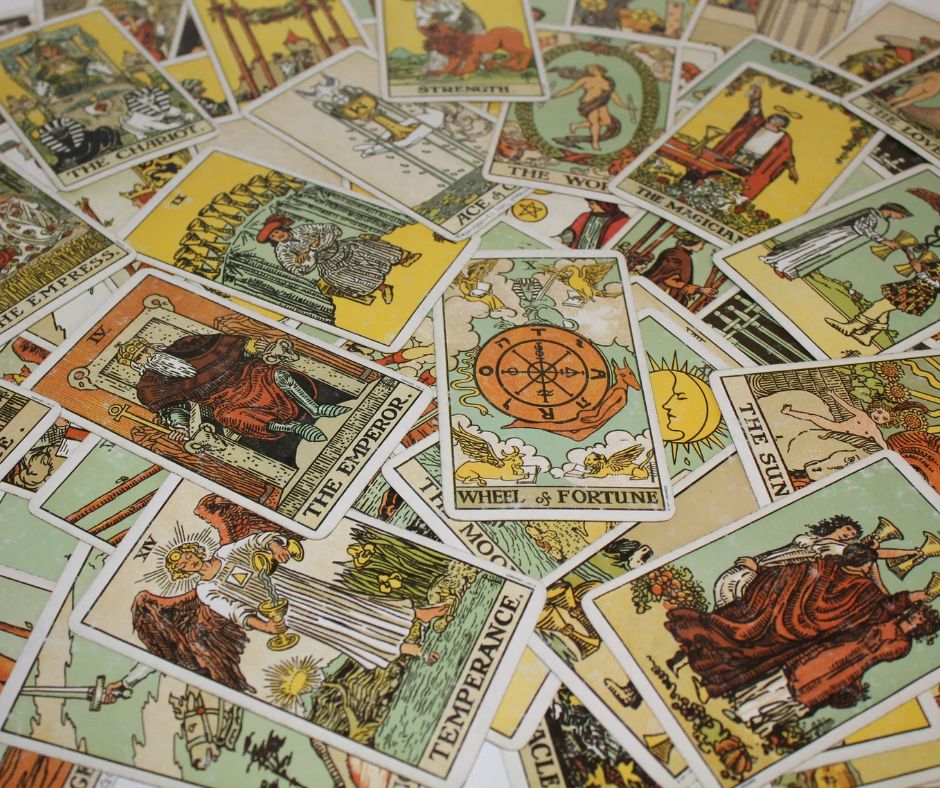
Long before we had Magic the Gathering and Cards Against Humanity for game night, people played card games to socialize. Playing cards began to appear in Europe from the Arab lands and China around the 1300’s and were often included in sermons of things that lead man to sin. We don’t know a lot about the early cards that came to Europe, but they were mainly used for games and not for divination. Playing cards were popular in Italy and many innovations and standardizations were Italian in origin. Playing cards were a luxury item reserved for only the most affluent and, of course, for Royalty. Each card had to be carefully hand painted and was a miniature work of art. Over time, printers figured out how to produce cards cheaply and they became popular with soldiers and eventually anyone could afford a deck.
The cards that became the divination cards we know as Tarot Cards began their existence to the card games of Italy. There was a series of games developed in Italy called Tarocchi or Trionfi. These games were played with a deck consisting of cards of four different suits and a longer suit called the Trumps. There is controversy among scholars and historians if these decks directly lead to the Major and Minor Arcana of the Tarot decks we know today, or in they inspired occultist of a way to set up a deck. The first mention of using the Tarocchi cards for cartomancy purposes wasn’t until around 1750.
Occultists took an interest in the cards used for Tarocchi and began creating the divination system we know today as Tarot in the second half of the 1700s. One of the first know occultist to develop the Tarot was Antoine Court de Gebelin, a French clergyman. While watching a group of women play cards one, he developed the theory that Tarot had its origins in ancient Egypt and was full of Qabalistic connections. He eventually developed his theory and wrote a dissertation on it in Le Monde primitive in the year 1781. Court de Gebelin is the origin of the common beliefs that Tarot is connected to Ancient Egyptian mythology and created the idea of all the Qabalah references in the cards. He even asserted that the word “tarot” came from the Ancient Egyptian word Tar meaning “path” or “road” and the word Ro meaning “Royal.” It should be noted that the language of the Ancient Egyptians had not be translated at this time in history and historians have never been able to find evidence to support his claims. People to this day, believe that the tarot is an ancient fortune telling system firmly rooted in Ancient Egypt.
Court de Gebelin’s fictitious history of the Tarot and its Ancient Egyptian connections we further enhanced by another French occultist, Jean-Baptiste Alliette, as he codified interpretations for each of the cards. He is mainly known for two things in history. One, he wrote a book called “Way to Recreate Yourself with the Deck of Cards Called Tarots” (title translated from French), and two, he was the first known person to make a living off cartomancy. He influenced many people during his time, including renowned French Court cartomancer Marie Anne Lenormand, and his work is still read to this day by occultist and tarot fans. In 1789, he published the Tarot do Marseille, one of the modern standard deck styles.
Eliphas Levi was the next major occultist to take us the Tarot and make his mark on the practice today. Levi was a supporter of Court de Gebelin’s interpretation of the cards and their origins and considered everything that Alliette said about the tarot to be wrong. He claimed that the tarot existed before Moses and that it was a universal key to the mysteries and the universe. In all, Levi is known for modifying the images on several cards, associating the Major Arcana with the Hebrew Qabalah and the Hebrew alphabet, linked the numbered cards in the minor arcana to the 10 seirot or emanation of the Qabalah, and worked out more of the symbolism. Levi’s influence on the cards is seen to this day.
Over the next century or so, various occultists, secret societies, and practitioners added to the lore and code of the tarot. The 1880’s saw a boom in interest in the tarot and its adoption into the English-speaking world. The first work on tarot was published in 1886 by Arthur Edward Waite. In 1888, the Hermetic Order of the Golden Dawn, established the tarot in the English-speaking world with the publication of a book called “The Tarot: Its Occult Signification, Use in Fortune-Telling, and Method of Play. The Golden Dawn never released an official deck of their own, but various members designed and released decks including two of the best-known decks in the world, The Rider-Waite-Smith deck, and the Thoth deck.
Tarot is experiencing a resurgence in the world and the variety of decks available to readers is incredible. Most decks designed today follow one of two models, the Tarot de Marseille, or The Rider-Waite-Smith deck. One of the main differences between these decks is that in the Minor Arcana, the numbered cards of each suit have a pip design like seen on standard playing cards. RWS style cards will have an image related to the meaning of the card instead of pips. If you have an interest or hobby, there is probably a tarot deck out there for it. Some decks can be very serious, and others can be very lighthearted.
When looking for a deck to read, look for something that appeals to you. You will sometimes hear readers say that a deck should “speak” to you, by this they mean that it should appeal to you, when looking through the cards you can tell what is going on, and you can feel like they would work well with you and your beliefs. They should feel and look nice to you for what your goals are with that deck. Also, keep in mind that different decks are designed for different purposes. A very serious, traditional deck is going to want to be studied more and provide more serious reading than a kawaii, light-hearted deck. For example, I have a deck with racoons on it, that deck reads well for introverted, neuro-divergent focus questions and my Faery Wicca deck likes to answer question dealing with grand events in life and divine connections. And yes, it is ok to own more than one deck, I collect limited run decks that make me happy or make me think.
Tarot may not have a hidden, ancient tradition that spans to the shadows of time, but they are relevant today. They are a great tool to gain insight into your, or the person you are reading for's life and they allow us to explore our inner world to bring order and healing to the chaos that is our lives.