It Grows in the Woods: A Brief History of Wild Plants in Magic
When did humans begin to forage for herbs to use magically, medicinally, and culinarily. The history of herbs is ancient and rich.
WITCHCRAFTWITCHCRAFTBASICSHERBALISMMELISSA
Melissa Wittmann
7/8/2025
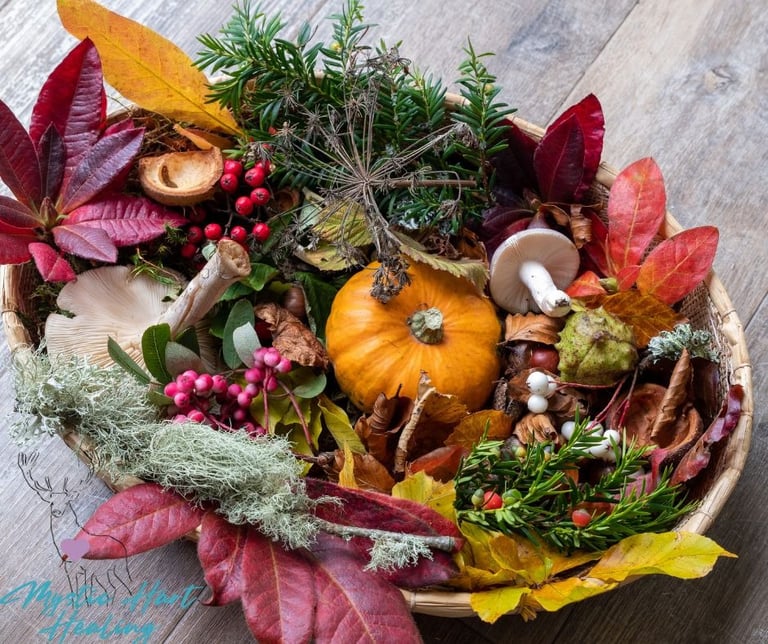
We’ve all seen an image of the witchy looking woman in the woods with a basket of hers in her arms. That image is based on the fact that before the days of internet shopping, witches would often have to forage for spell and potion supplies.
In fact, humans have been foraging for food and medicines since the day we decided to walk upright and leave the trees behind. We evolved from scavengers, and we still do it today. We no longer need to be hunter-gatherers, but some of the skills and instincts are still there.
Just a quick note, I’m going to be saying hominids a lot because I consider out previous evolutions just as important in this story as the evolution we are today.
We are talking about a history of approximately 2 million years. That is the time that we diverged from the great apes on the primate family tree. They learned to walk upright, use tools, explore new lands, figure out was edible and what made you taste colors, and so much more. Our ancestors were far from the stupid cave dwelling knuckle draggers that movies and the comics page make our ancestors out to be.
They learned which plants you could eat, and which plants killed you. Which plants helped heal illnesses, reduce a fever, and which ones could kill you if you consumed too much. They did all this without being able to write things down or keep an herbal BOS. Something tells me that when the herb people in a group met up with the herb people of another group, they shared information.
How they figure out what was edible, medicinal, and poisonous? Since there are no written records, we, along with historians, just have to guess. The main theory is that our ancestors used trial and error with lots of observation. They would watch to see if the local animals consumed the plant and then tried it on themselves. Anything that causes illness or death was avoided and others were warned to avoid that plant. They also are believed to use their other senses when determining the edibility of a plant. Thing that smelled sweet or pleasing tend to be edible. Bitter smelling or unpleasant smelling plants were usually avoided.
Since leaves tend to be the most edible part of a plant, they were probably tested first. If the leaves were safe, then the stems, roots, bark, flowers, and fruit would also be tested. Once something was deemed edible, that knowledge was shared. Over time, our ancestors learned to control fire and this opened more plants to be edible.
The sheer amount of information early hominids kept in their brains is astonishing. Cave art involving depictions of plants is very rare. A few years ago, an archeologist (Georgina Walton) and her colleagues searched a cave art database for instances of plants in cave art. Out of 5,786 images they looked at only 4 had plants. They believe that plants were depicted in other artforms of the time and unfortunately those depictions did not survive history.
Over time our ancestors learned how to plant seeds for favorite food plants and grow them in a designated spot, rather than hoping to find a wild source of the plant. This process is called domestication, and it has changed life as we know it. This happened about 11, 400 years ago in the near east with a fig tree. Shortly after the fig tree, early humans learned to domesticate wheat, barley, lentils, and peas.
In 350 BCE, a Greek writer named Theophrastus wrote a 10-volume book titled “Historia Plantarum.” We only have 9 volumes of it in modern times. This is the first book of modern botany. He discussed plant classification, uses, plant reproduction, etc.
2000 years ago in China, a book was compiled with the name of “The Devine Farmer’s Classic of Herbalism.” This book is considered the oldest herbalism book. It is a collection of herbal information and has helped to develop many herbal pharmacopoeia and lists of uses for herbs.
Even with plant domestication, some plants refuse to be domesticated. The plant refuses to thrive when domesticated. Since an herb can’t be grown in your cottage garden, you must find it in the wild and thus go foraging. Our more modern ancestors would don their cloak, grab there thug (herb gathering basket), and head off to the woods in the hopes of finding the herbs and plants they need. Even with cottage gardens, foraging was quite common throughout history. If you managed to gather more than you needed for what you were doing in the moment you could dry for later use or maybe sell the extra in the market.
Throughout history, plants used in herbal medicine, poisons, and witchcraft were often given folk names and developed folklore around them. Even some everyday foraged food plants had folk names. If you learned a plant’s name from your mom or granny, you probably learned a folk name. This was done for several reasons. First, many people lacked the formal education to learn the proper names of plants. For example, if you were told to gather Englishman’s foot, you would look for what we call plantain. It was believed that everywhere the English stepped, plantain grew. The witches’ brew from MacBeth was an actual herbal formula. Eye of Newt is just mustard seeds and Toe of Frog is buttercup leaves.
Second, folk names were used to obscure the true plant being used. Sometimes the community and the local church got a little nervous about what a person was foraging for and using especially if the recipe was written down. This was also done in alchemy texts.
The third reason could just be a mnemonic to remember the herbs. It may be easier to remember a nickname that describes the plant’s appearance than to remember the proper name.
People still forage in modern times. There are people who take vacation days so they can forage for morels during morel season or forage for truffles during truffle season. There are places that teach foraging and how to forage responsibly. Some survival groups even offer classes on what plants in the wild are edible. And witches are still known to go into the woods and gather herbs they need for their spell work. There is something special about finding your components in the wild instead of just ordering them online.
Whether you decide to forage is up to you. Some witches don’t have the woods nearby to forage in. Others feel that foraging is the only way to get powerful spell ingredients. Personally, foraging is fun, but if you don’t have access to wild places to forage that doesn’t make you less of a witch. Witches are adaptive our power comes from within.