Grimoires and Their History
What is a Grimoires and where do them come from. Learn the history of the Book of Shadows that witches keep.
WITCHCRAFTWITCHCRAFTBASICSHISTORYTOOLSMELISSA
Melissa Wittmann
8/9/2024
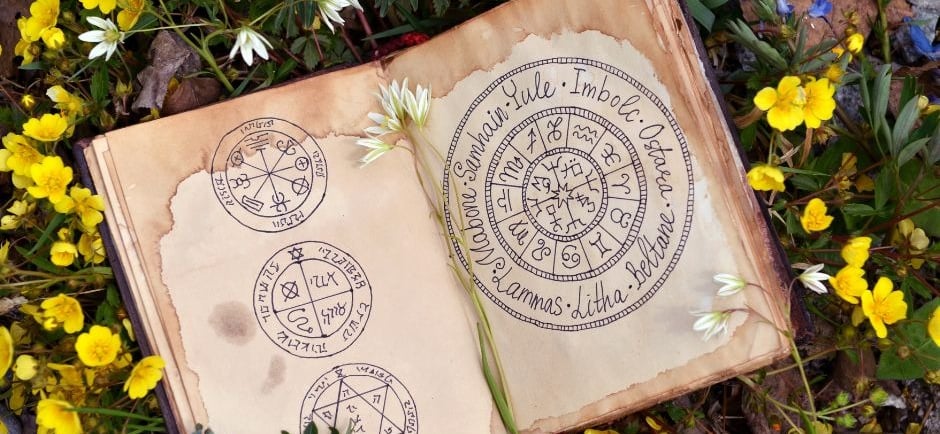
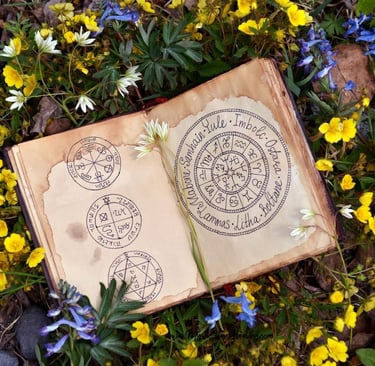
If you’ve only heard the word “grimoire” in movies and TV shows, then the word probably brings to mind a big book, bound in some dark, questionable leather with pages filled with strange drawings and off looking script. Characters will mention it in a hushed, fearful tone and the warning to never read aloud from it. That popular horror movie trope is only about ¼ true.
Real life witches often do have grimoires. A grimoire is a place for a witch to keep their spells, rituals, observations, thoughts, and notes. It is a lot like a magical diary or journal. The earliest known magical document was a clay tablet covered in cuneiform writing that contained magic spells. This little clay tablet was possibly someone’s magical journal or notes from the city of Uruk sometime in the 5-4th century BCE. Imagine writing a spell so important to you, that you end up being the creator of the first magical document.

Ancient Egypt was fond to writing down their knowledge and keeping records long before Alexander the Great traveled there. They referred to their system of magic as Heka and after the arrival of Alexander the Great, it was expanded and recorded. As the Egyptian system of writing was codified and refined, their desire to gather knowledge and write stuff down expanded. The Library of Alexandria is said to have contained scrolls and books on a vast number of magical topics written in languages raining from Hellenistic Egyptian and Greek to Roman-Latin, Coptic, Cuneiform, and many more. Sadly many of those original grimoires were lost when the library burned down and was disbanded. I feel sadness when I think of all the magical knowledge and tradition that was lost.
In the 3rd Century BCE, a mysterious figure became the father of modern grimoires. He was known as Hermes Trismegistus and some claim he was a god incarnate. There is great debate on whether he as Greek or Egyptian or neither. His name means Hermes the Thrice Greatest. Some contemporaries thought he was the god Thoth incarnate to share his vast wisdom and make man more powerful. Others said that he was the god Hermes delivering wisdom the gods wanted shared. Nobody knows his true identity, but he influenced both Muslim and Baha’I writers and was described as the Prophet Idris from the Biblical book of Enoch. Through the years his identity has been debated, but the grimoires he wrote still influence magical traditions to this day.
The Greeks and Romans credited the creation of magic books, or grimoires, to the Persians. Pliny the Elder in the first Century CE, credits Zoroaster in circa 647 BCE with creating magic. Magic wasn’t written down by Zoroaster, but rather a magician and follower of Zoroaster named Osthanes in the 5th Century BCE. Modern historians maintain that Pliny’s story is not supported by historical evidence so the story of Zoroaster being the inventor of magic is often dismissed.
Many Jewish traditions maintain that Early Jewish people began writing down the magic and ideas related to it that they believed around the time that Moses and the Israelites were enslaved in Egypt. It is said that Moses learned and write down the magic of the Egyptian Priests. The Sixth and Seventh Books of Moses are purported to be the writings of Moses while in Egypt. Among other things written down by Moses were ways to call forth a demon to do your bidding and how to subdue and, if need be, banish a demon.
“The Testament of Solomon” written by King Solomon is believed to be one of the oldest magical books written. It was a Greek manuscript that was written in Egypt or Babylon sometime in the 5th Century BCE. The book contained all the popular magic of the time including rituals to summon and banish demons. There is no possible way the book was written by Solomon, because it was written approximately 1000 years after Solomon’s death. Scholars believe that King Solomon’s name was added as the title to legitimize the book and create a buzz about a magic tome written by a great King.
There are several Sects of Early Gnostics that are purported to be magical in nature and possessed books that were included in the early biblical texts that were later removed from the Bible. Historians believe that these books were left out of the Bible because they magical information was heretical to the way the early church fathers wanted the bible story told. Several of these texts were found whole or in part among the Dead Sea Scrolls.
“The Book of Enoch” was one of those lost gnostic books. In the Bible, Enoch was the father of Methuselah and the great-grandfather of Noah. This is the book that presents the reasons why the angels fell from Heaven and how the Demons and Nephilim came into being. It also goes in to detail on why God thought the floods were necessary to cleanse the Earth. Original copies of this book, written in 300-200 BCE, do not exist. The oldest copy was found in the Dead Sea Scrolls; however, parts of it existed in antiquity and those parts became the text of the grimoire of the “Book of Enoch” which was an early source on demonology, astrology, and angel working.


The Middle Ages when Europe began to be dominated by the Catholic Church frowned upon grimoires and other books of magic; except for when they didn’t. The use of magic books was so widespread that efforts to destroy all books of magic was futile. New books kept popping up that were written by Christians (many times written by clergy), pagans, Jewish scholars, and even followers of the new faith from the Middle East, Islam. So rather than fight a losing battle, the Church created two categories of magic. Natural Magic was the belief in magic centered around the forces of nature and, thus, magic revolving around God’s Creation. This magic was allowed as long as it didn’t take away from the message of the Church. On the other hand, there was Demonic Magic. This is magic that the Church felt detracted from it’s message and took power away from God. If the Church didn’t like it, it was Demonic and the book and writer were destroyed, often by fire. This included any topic that was deem from the Devil and worked against the natural order of God; including books on divination, demonology, and necromancy.
Scholars, clergy, and even Popes wrote magic grimoires and treaties on magic during the Middle Ages. We do not know the true authors of many of these books because it if was vaguely controversial or the author wished to make the book seem more important, the book was credited to be a found book by an ancient person. It would be akin to writing a book full of predictions today and crediting it to Nostradamus to give it a little star power. Some people didn’t care how ancient the wisdom was, while others felt that magic books with fake pedigrees should be destroyed. Francis Bacon wanted to make it illegal to credit a book to ancient writers when they weren’t the writers.


The Renaissance changed the face of grimoires forever. Events such as the Protestant Reformation, the invention of the printing press, and the wide-spread witch-hunts throughout Europe changed the way magical books were written and shared. The Renaissance led to the creation of Hermeticism and Ceremonial Magic. Hermeticism is a magical and philosophical system based on the writings of Hermes Trismegistus. Hermeticism is still practiced to this day and it’s principles have influenced a lot of modern Pagan beliefs and terminology. Ceremonial Magic is a field of magic that utilizes elaborate rituals and very specific tools and props utilized during the ceremony. Ceremonial Magic tends to be academic towards its study of magic. Both systems led to a vast abundance of magical books and Grimoires. Latin or other language texts we translated into the languages of the era. The printing press made it possible to publish books in bulk and ideas could be shared with ease to the literate classes.
People like Pico della Mirandola and Johannes Reuchlin helped spread an interest in the Jewish magical system known as Kabballah. Despite much of Europe being anti-Jewish at the time, there was still a lot of interest in their magical system. This interest in Kabbalah inspired future generations and magical beliefs.
Henrich Corenelius Agrippa was a Renaissance Era German who was a man of many jobs including occult writer. During his life he was a soldier, physician, legal scholar, occult writer, and a theologian. His books on magic and the occult are still studied today in many magical circles. His grimoires are still studied. In addition to the writing he did in the occult field, the also developed the Angelic script while studying the Angelic Spheres and the language to communicate with angels.
The final great name of Renaissance grimoire writers to mention is this article is Paracelsus. The name Paracelsus was a magical name or a pen name for Swiss alchemist and lay theologian Theophrastus von Hohenheim. His writings included writings on toxicology, Universal knowledge, his extensive travels, medicine in general, alchemy, and magical philosophy. He wrote many books and papers during his life and developed the distinction between good and bad magic.


During the Age of Enlightenment into the Victorian Ere, printing presses continued to publish grimoires both old and new. It was popular to attribute newly written books to ancient figures to add a layer of mystique and authenticity to them. Grimoires grew in popularity as people began to form secret societies and Masonic Groups.
In the 20th century, grimoires continued to be written and a new magical book was added to the vocabulary, a Book of Shadows. With Gerald Gardner and the rise of Wicca the public began referring to coven based and personal magic books as a Book of Shadows. Within Wicca, you received the coven you were training with’s Book in segments, so that by the time you were ready to hive and lead your own coven, you had the complete book. Many Wiccan Books of Shadow are considered oathbound and not shared with the public and only shared within the group.
What was once the domain of mysterious academics is now widely available to anyone with an internet connection and the ability to search Google. A modern witch’s Book of Shadows can be in any form that they wish, including spiral bound notebooks, leather bound journal, a favorite ring binder, a portable drive, etc. There are no rules as to what needs to be in a personal book or books. Modern personal grimoires are more a record of your research and journey than a written academic study. You can even find digital copies of many of the ancient grimoires online if you wish to read and study from them.
With the access of great knowledge also comes with a need for great discretion, anyone can put magical writings on a webpage and call it legit; however, be careful of magical writings of strangers. Not every bit of knowledge comes from an understanding of magic. If a spell called for essential oils or herbs, research those herbs. I have seen on several occasions, ritual teas that contain toxic ingredients.
From bits of clay tablets written in cuneiform to modern cloud storage, the history of magical writing is a long and fascinating topic. As technology developed and human attitudes toward the acceptability of magical studies changed so did what was written. We are alive in a great point of history where in many places we are free to study our magic and write about it. The works of the past are an internet search away.