
Four Thieves Vinegar: The Secret to Surviving the Plague
Can an herbal vinegar keep you safe from the plague? There are four thieves that believed it could. Learn the history of 4 Thieves Vinegar and learn how to make it.
WITCHCRAFTWITCHCRAFTBASICSSPELLCRAFTHISTORYTOOLSHERBALISMMELISSA
Melissa Wittmann
1/14/2025
History of Vinegar-Medicinal & Culinary
Medicinal vinegars have been around as long as vinegar making has existed. Or in other words, medicinal vinegar may have been one of the first medicines. The process was simple, take vinegar and steep with herbs and such. Found all over the ancient world from China to Greece to parts of the Gallic Empire, people used special vinegars to fight infection and clean their living spaces. Depending on what herbs were steeped in the vinegar. Medicinal vinegars were used to treat everything from simple cuts and scrapes to chronic diseases with success.
There are accounts of vinegars made from dates, beer, and figs being used medicinally, and culinarily around the year 3000 BCE. This is one of the earliest accounts of medicinal vinegars. Babylon was not the only civilization of the ancient world that was utilizing the medicine of vinegar. When tested for residue, ancient Egyptian urns showed traces of herb steeped vinegar. Meanwhile, during this time period in Zhou Dynasty era China, the formulas and recipes for culinary and medicinal vinegars were being written about.
Our ancestors loved their vinegar, no matter where in the world they were. Vinegar helped preserve food, helped keep their residences clean, healed ailments large and small, and repelled insects. Vinegar making became a respected profession and areas began to refine their process and develop distinct vinegars based on the supplies a region had. England began to develop Malt vinegar by basing their vinegars with malt-based ales. Apple cider producing areas began to refine the art of making apple cider vinegar. Rice wine vinegar and persimmon vinegar began coming from Asia.
The Tale of Four Thieves
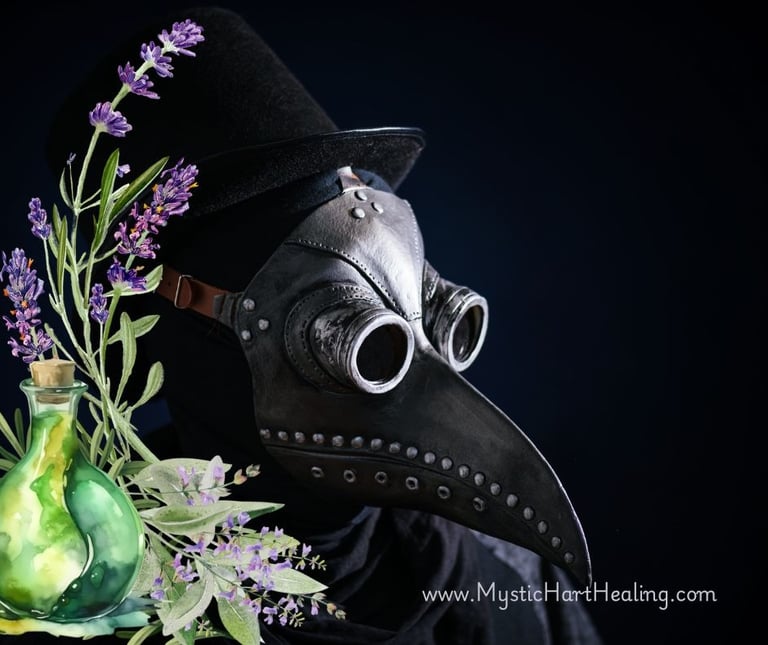
During the Plague of Marseilles sometime in the 1720’s, death and despair was everywhere. People were dying everywhere the plague touched and those who weren’t dying from the plague were dying from starvation. The Beaky Men or Crow Men, a.k.a. the doctors treating plague patients, did the best they could with the lack of effective medicine allowing more patients to die than survive the illness. Things were bleak and people were scared.
Four young men developed a plan to escape the plague-ridden city and start a new life before the illness in the city cut their lives short. This plan was simple, they would rob the dead of anything of value and use that loot to start new lives elsewhere. After all, the dead didn’t need gold and you can’t buy your way into Heaven with a hidden treasure trove or a necklace made of precious jewels.
Some people say that at least one of the young men may have been an apprentice to a doctor or an apothecary, because they knew enough about herbalism to keep them safe. Each night that they went out to rob the dead, they would apply to any exposed part of their body a herb infused vinegar and all of their clothing was soaked in the same vinegar. They may not have smelled pretty but between the fact that the city had a stench of death, and the dead never mentioned the smell, they didn’t care.
The Four Thieves, as they became known, went out often to commit their crimes. For a while, some people thought that it may have been a Crow Man doing the robbing, but it was just our thieves following the doctors. When the doctor would leave a house and tell his fellow Crow Man that no one in a house could be saved, the thieves would sneak in and rob it before the carts-men would make it there to take the bodies to the grave.
They did very well for themselves. Remembering to always stash their ill-gotten gains away from where they worked and lived. They were even making plans for where they would disappear to and start over. That was until one night when the town guard was waiting for them. As soon as they snuck into a house, the city guards were waiting for them and arrested our vinegar-soaked thieves. The city leaders wanted a speedy trial and thus the next day the thieves were tried before the city judge. The sentence of death by hanging was handed down to the thieves. The next day, the Judge’s daughter caught the plague, so the judge decided to strike a deal with the thieves, tell me how you magically keep from getting sick from the plague even though you touched the plague dead, and I will let you go free.
The thieves agreed to the deal and carefully wrote down the formula for the vinegar concoction they used to keep them safe from the plague. At Midnight on the day the judge offered them freedom for their cure, they handed the judge a paper with the recipe neatly written on it and disappeared into the night with their loot. Nobody knows what happened to the thieves and history never recorded their names. The Vinegar recipe they gave became known as Four Thieves Vinegar and is a staple of medicinal vinegars to this day.
Four Thieves Vinegar and Oil
The exact recipe the thieves gave (supposedly) is not known today and there are several recipes that have been handed down that claim to be the original recipe. There is a lot of variation in the recipes, but they do have some things in common. First, they all work on the base of a wine or apple cider vinegar, they all have herbs and resins infused in the vinegar, they all have medicinal properties, and finally, they are an insect repellant.
Some of the herbs mentioned in recipes can include, but are not limited to, the following herbs: thyme, juniper berry, rosemary, cinnamon, black pepper, dried sage, dried lavender, rue, camphor dissolved in alcohol, fresh garlic, bruised cloves, mint, and wormwood. Originally, Four Thieves Oil was not consumed because some of the herbs included were toxic in ingested. Even today, you should never consume anything that you know contains possible ingredients or anything that you don’t know the ingredients of. Topical use if fine if you don’t show an allergic reaction to herbal vinegar.
The thieves were very knowledgeable when they created their vinegar. Some of the medicinal properties of Four Thieves Vinegar include being an antiseptic, anti-fungal, an analgesic, a dewormer (in some formulas), a natural barrier to infection, protector against respiratory illness, a disinfectant, a sanitizer, and a bug/flea repellant.
Four Thieves in Modern Times
Many herbalists, folk medicine users, and witches still use Four Thieves Vinegar in modern times. Often it is used to cleanse and protect an area and the inhabitants of that area. Energetically, it is said to banish negativity, promote healing, and protect an area from harm and illness.
Medicinally, during cold and flu season, the vinegar can be used to clean the home when someone is ill or sick. Add a few drops of the oil or vinegar in a mop bucket then the floors get washed. Wipe the walls, doors, and surfaces with solution infused with Four Thieves Oil. This will help kill germs that may be lingering around. You can even add a few drops of the oil to your laundry to kill any germs. It is said that Four Thieves Oil, and the vinegar form, can have a strong medicinal scent.
Also, outside of flu season, a few drops can be added to your shampoo to help treat dandruff or to a basin of warm water to treat nail fungus and athlete’s foot. If you use Four Thieves oil as a dandruff treatment, thoroughly condition and moisturize your hair afterwards. It can also be used as a bug repellent. Check with your veterinarian before applying Four Thieves Oil to any pet.
Four Thieves Oil and Vinegar can be cheap to buy or make and is a powerful addition to any household supplies. Just use it wisely.
Please note, Four Thieves Oil is an essential oil made from the herbs used in the vinegar without the vinegar base. It works in much the same way the vinegar works but without any properties the vinegar may add. It is advised that you do not consume Four Thieves Oil internally, do not apply to skin without a carrier oil, and never give to pets or small children.