Divining with the Game of Hope
An look into the oracle deck called Lenormand. A little history and a little magic.
MELISSADIVINATIONHISTORYWITCHCRAFTWITCHCRAFTBASICS
Melissa Wittmann
6/15/2023
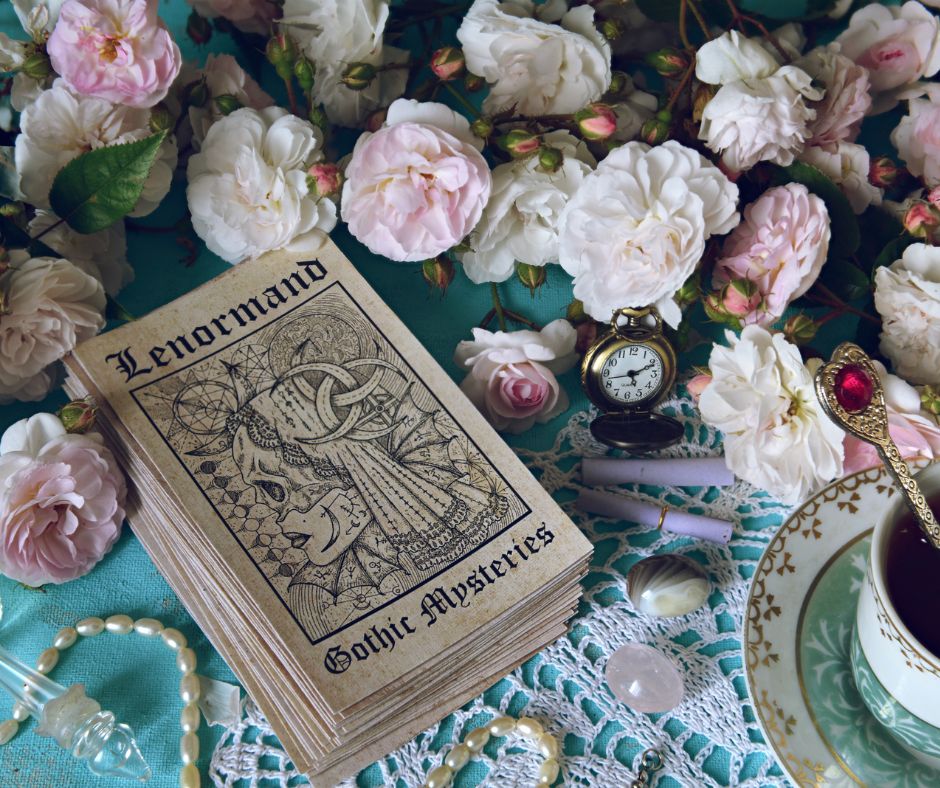
I found out about Lenormand by accident. Around 2018, I saw an announcement that one of my favorite artists, Jamie Sawyer, was making a divination deck and I went to her Kickstarter, backed her deck, and found my divination passion. Her deck was beautifully illustrated with colorful images done in the style of tattoo art. It was a Lenormand deck and at the time, a new to me form of cartomancy. My only problem with the deck is that it didn’t come with a booklet, I used my knowledge and began reading them like I would read tarot or any other oracle card. After a bit, I took to the internet to learn more about reading this deck of cards.
Lenormand was created around 1799 in the Nuremberg area of Germany as a card-based game of chance called Das Spiel der Hoffnung or The Game of Hope. It was designed to be laid in a 6 card by 6 card grid and played like a board game. There are copies of the rules that can be found online if you ever have the desire to look for them. People quickly figured out that these cards could also be used for divination. The card game quickly spread to Italy and France and ended up in the French Court in the hands of Madam Marie Anne Lenormand. She was a writer, fortune-teller, and accused practitioner of necromancy during the Napoleonic Era. Some historians consider her the greatest cartomancer of all time. She was an active practitioner of cartomancy for over 40 years and included such note-worthy people as Maximilien Robespierre, Empress Josephine, and Tsar Alexander I of Russia among her clientele. The style of cartomancy she employed was named after her. Lenormand fell out of favor after her death but started to gain in popularity again in the 2010s.
Lenormand is a form of cartomancy (divination through cards) that can be done with a regular deck of cards edited to include only 36 cards or can be done with a special deck called a Lenormand Deck. Each card has a symbol, and those symbols are laid out in odd numbered groups called rows. The spreads usually consist of grids called Tableaus. The subject of readings usually deal with personal subjects and not grand, world changing events. Each row of cards is connected into a story called a combination. I know all this sounds complex, but it is really quite simple once you see it in action.
Let me give you an example: You are reading for yourself and want to know about your new job. The cards are shuffled, and a row is dealt on the table, with the first row being what is the new boss like. The cards are Sun, Birds, and Clover. You look up the meanings of the cards and discover that the Sun is usually a cheerful, friendly person, birds are people that are all about oral communications, and Clovers are generally positive, but focused on results. Looking at that you determine that the new boss will be an upbeat, friendly person, but they are focused on results and would rather be told something than receive an email on it but watch out birds can also be gossips.
Because I didn’t learn about the rows and tableaus part of Lenormand until after I learned to read the cards, I have the tendency to read them like tarot cards and use tarot spreads for my reads. They work well for that, and I’ve talked to several Lenormand readers who read them tarot style because it is a system that many people understand.
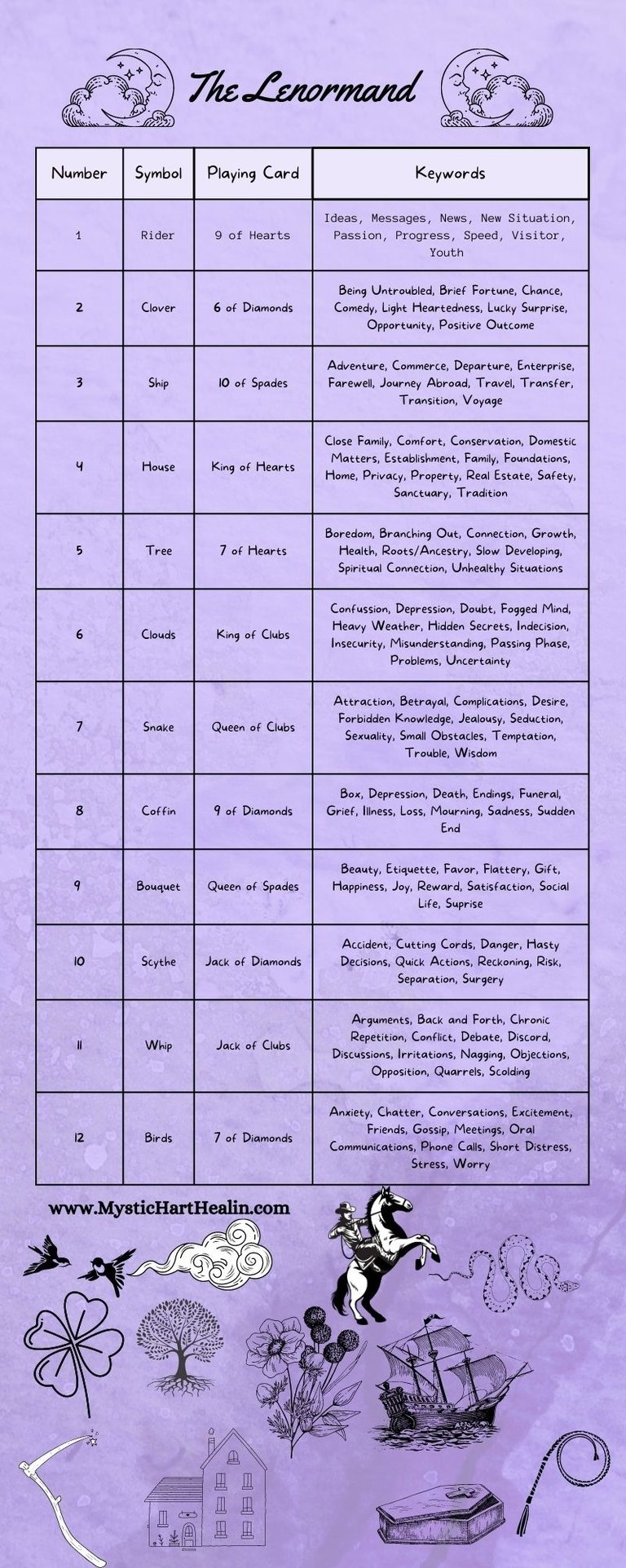
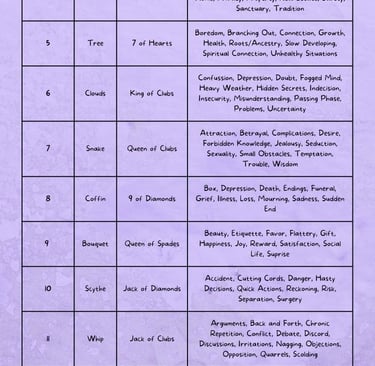
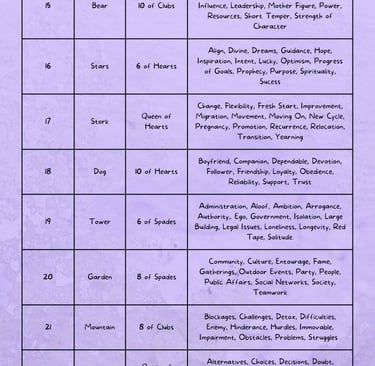
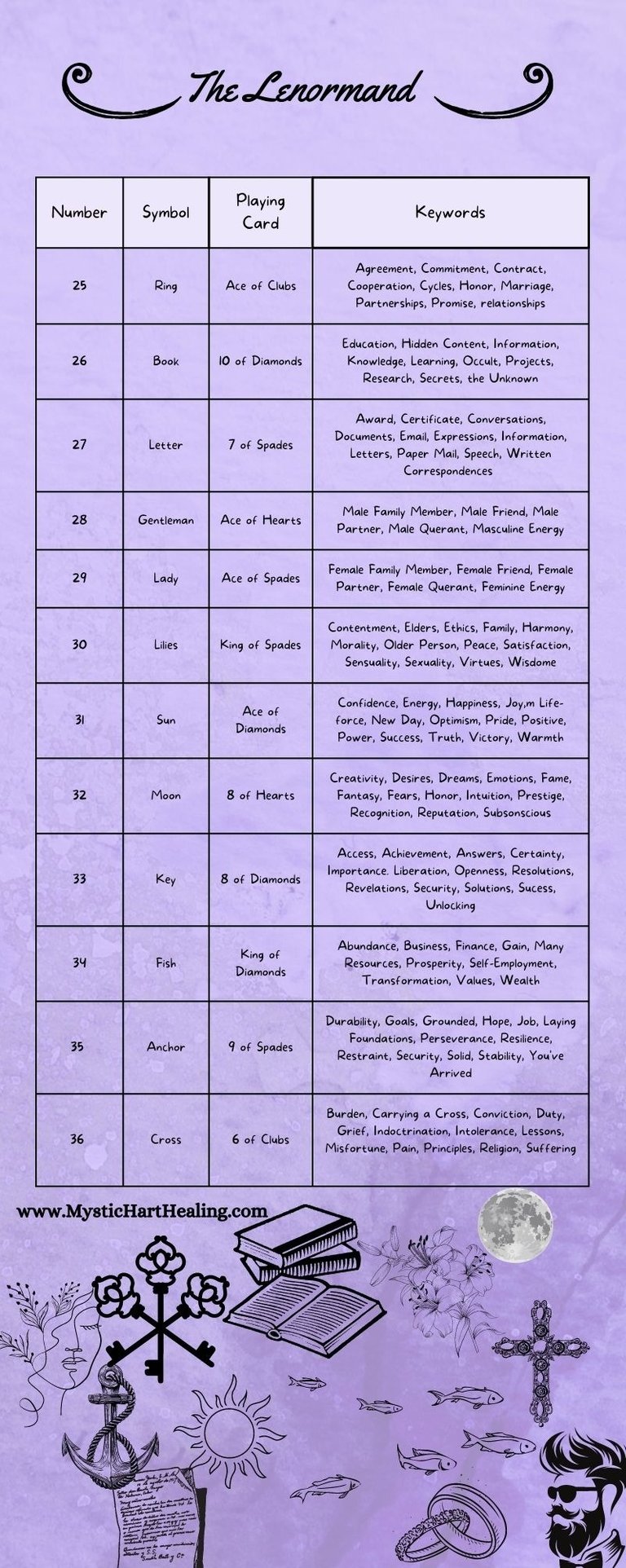
There are 36 cards in a Lenormand deck and each card has a symbol on it. Each of those symbols has a meaning and an association with a regular playing card. Below I’ve listed the symbols, playing card ,and keywords if you wish to learn to read them. Generally, Lenormand upside down cards are just turned to an upright position for reading.