Curses, Hexes, and Jinxes
They are the same thing, right? Take a look at what they are and how they are used, how they are different, and how they effect your witchcraft.
WITCHCRAFTWITCHCRAFTBASICSSPELLCRAFTMELISSA
Melissa Wittmann
6/11/2024
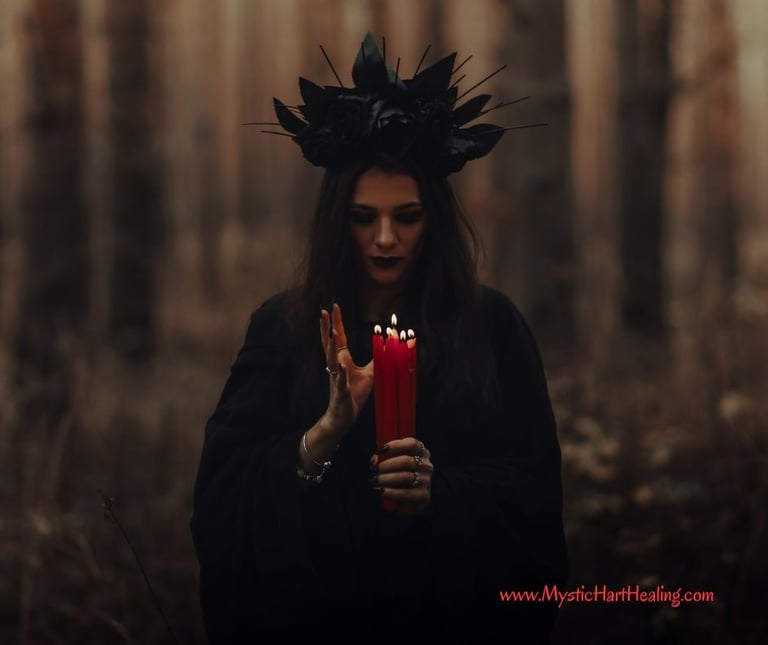
Have you ever been through a period of bad luck and feel like you have been cursed? Or maybe you have had someone say that they hexed you because they didn’t like the way you looked at them? Chances are you are just having a little bad luck, we all do, and that person hasn’t hexed you for looking at them the wrong way at the grocery store. Curses, hexes, and jinxes are an ancient form of magic that is designed to inconvenience at the least and cause harm at the most.
Curses were a common part of the ancient world. They range from the simple to the complex. Often referred to as baneful magic, evidence of them can be found all over the world. One of the oldest curse tablets was found is Pella, an ancient Northern Greek city in an area once known as Macedonia. This little lead scroll is inscribed in Doric Greek dates to the 4th Century BCE. Not only does it give scholars a look at the Ancient Greek language, it also give us an example of the magic of the time. On the tablet, we learn that Phila, or Dagnia, wants to prevent the person she loves, Dionysophon, from marrying someone else. She curses the man’s love interest and magically tries to lure the man back to her with an offer of a long, happy marriage. She invokes a demon named Makron and his demons to prevent the man from marrying the other woman, Thetima, and will only release the curse when Dionysophon marries her. As was the custom of such a curse, the scroll was buried with the body of a recently deceased man in the hopes that the man’s spirit would carry the message in the Underworld to the hands of Makron. This curse is one of the oldest written curses that we have found.
The Ancient Egyptians had their love for curses. They would use curses often as a form of protection magic. Curse spells would be inscribed into tombs to prevent graverobbers from looting the graves of wealthy loved ones. The famous Book of the Dead contains several curses to aid the soul in the Afterlife.
But the Egyptians were not the only ones who indulged in curses in the ancient world. There are many texts of observed curses and how to cast curses that were written in our past. Small clay tablets and metal scrolls containing curses have been found in many languages and many locations. Curses would be placed on tombs and sacred places to protect them. Royals and peasants alike had curses placed on them and placed curses on others. At some times in the past, a person could hire someone to cast a curse for them for the right price.

So what are the differences between a jinx, a hex, and a curse. Some people use the words interchangeably, but there are differences between them. They are all considered forms of baneful or dark magic. Each is believed to have a karmic, spiritual, and energetic price attached to casting them. Whether you use these types of spells in your magic depends on how you ethically view them within your beliefs.
Jinxes are little bad luck spells that are directed at someone that are relatively short term and harmless. They are don’t designed to harm others as much as mess with their life or teach them a lesson. This is the easiest to cast and can even be cast without realizing it. Jinxes are just mean-spirited stumbling blocks put in someone’s way. Comon examples of jinxes include jinxing someone to always hit a read light for a week because they almost hit you while running a red light, jinxing someone to have a stone in their shoe when they walk to add to their discomfort., sending someone nightmares, or even just jinxing someone to lose every time they gamble for the next several days. The effects usually last a very short period, anywhere from minutes to maybe a month. Karmically, they are pretty minor because they don’t cause real harm.
Next on the level of severity are hexes. Hexes are cast to inconvenience the target seriously. They must be cast with intention; it is extremely rare for a hex to accidentally be cast. They last longer than a jinx and can cause non-fatal harm directly. Karmically, they carry weight and many who ethically don’t believe in causing harm will refrain from hexes except in self-defense or protection instances. Hexes are often cast to inconvenience someone or to teach them a serious lesson. Examples of common hexes include: make someone lose hope and joy in their life just like they made you lose hope and joy, hex someone to have trouble finding a love that they can trust, a hex to alienate someone from their love ones, make someone physically ill every time they do a certain action, or make the target regret leaving you by making everything remind them of how beautiful your relationship was.
A note on the word “HEX”. The baneful magic hex is not the same as the hex cast by Pennsylvania German or German witches. A hex in German witchcraft is just a spell. It is the world used for a spell and witches sometimes refer to themselves as Hexer, Hexen, or Hexeri. That does not mean that some German hexes are not baneful hexes also.
Finally, a Curse. Curses are cast with intentional focus with a very specific goal and punishment in mind. It is believed that they cannot be cast by accident. They are used to bring harm, suffering, and destruction to the target of the curse. They can be short term, long term, and, even, generational. They are serious magic as the subject of the curse can have their lives ruined and, in some cases, may even die. Curses can be placed on a certain person, an object, a location, or a population of people. They are serious baneful magic and should only be used in the direst of situations. Casting a curse can be physically, spiritually, energetically, and mentally draining. Common modern curses can include things like: cursing someone with a serious illness, making an abuser experience the abuse they inflicted on others, curse someone to fail in life and lose everything they have, or curse someone to always feel alone in life no matter how many people are around. Curses can also take a toll on your mental health, witches who cast curses for the slightest thing and start witch wars with everyone are not powerful, they need help with their mental health.
The ethics behind jinxes, hexes, and curses is up to the caster to decide. Many modern Wiccans who follow the modern Rede (Do not harm but take no shit!) will only cast these in instances where self-defense or protection are needed. They will think long and hard about baneful magic and the situation before doing something that could harm themselves or others.
There are those who seek power over others and will dabble in baneful magic as a way to supposedly gain that power over. They do not care about the ramifications of their actions as long as they get the power they seek. They consider those spells as a means to the end.
Mercenary witches are those witches that will cast a hex for someone for a price. They care little for the ethics of their actions or the effects those curses have on the lives of others as long as they get paid. If you go this route with your baneful magic, thinking that you will avoid the blowback of what you are doing, this is not a loophole in responsibility. You will still get that blowback from the Universe.
Ultimately, it all comes down to how you believe the Universe reacts to curses, hexes, and jinxes. If you believe that your actions have ramifications and personal responsibility, you will look at the casting of curses in a very different light from someone who doesn’t. Any spell of this nature should be thought about and not be a reaction to perceived harm. If you are willing to pay the price, I can’t stop you, but ask yourself if you are willing to be responsible to the harm of others.