Anatomy of a Spell: Spells & Prayers
Are spells and prayer the same? are they different? Does it even matter? Take a look at the differences and similarities between a witchcraft spell and other religion's prayers.
WITCHCRAFTWITCHCRAFTBASICSSPELLCRAFTHISTORYMELISSA
Melissa Wittmann
2/19/2025
SAVE A PRAYER
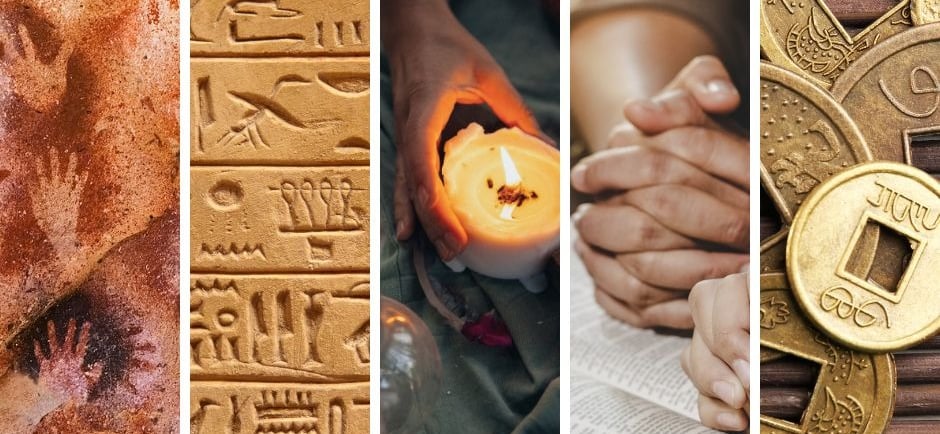
It may come as a shock to some people, but a witch’s spell and a Christian’s prayer work on the same principle. Yes, energy is directed to a different deity or aspect of the Universal Divine, but the basics are the same. Spells and prayers focus energy in the hopes that whomever one prays to will shift the energy around the person praying and bring about what is being prayed for. For example, you pray to God to connect you with a better job, and He guides you to meet someone who just happens to be looking for a person with your skills. That is not much different from someone casting a spell to Cernunnos to help you find a job and Cernunnos shifting energies to have you cross paths with the person looking to hire someone with your skill set. The concepts are the same, the names and methods are just changed.

HISTORY MATTERS
It seems that human beings have been casting spells from possibly before we were our current evolution of humans. Some of the paintings our ancestors left on cave walls are believed to have been magical workings to bring about plentiful hunts. We don’t know if early man, or even if Neanderthal man had religion or what that religion may have looked like, but there are cave paintings that resemble pictographical prayers for the benefit of the community.
The earliest known spell that we have found was a clay tablet from the Mesopotamian city of Uruk that dates to the 4th or 5thcenturies BCE. This tablet was written in cuneiform. Spell-craft was not all that unusual in the Ancient world. Remnants of spells and entire spells have been found in ancient Egypt, Ancient Greece, Ancient Rome, and Mesopotamia. Archologist have found evidence of written spells, amulets, talismans, scripts for spoken word spells, magical symbols, and even candle spells. Not that everyone in these ancient cultures was doing spell-work, there is abundant evidence that spells were popular. More religious people in Ancient Rome and Greece did not cast spells because they believed that personal spell casting was an afront to the Gods and that the priest were the only ones who would commune with the Divine. In some areas of Ancient Greece and Rome, there were even laws that banned any magic or spell that could kill someone, with the punishment often being execution.
The rise of Christianity and Judaism changed how spell-craft was seen among the populations. Both religions were anti-magic and at one time or another, outlawed the use of magic and spells. Spells were often believed to be evil and to cast a spell was to forsake God and his plans. This anti-magic attitude evolved into making spells and magic a sin and at some times, it became a sin punishable with death.
The punishment for casting spells became stricter over time. In the early days of Christianity, the punishment if you were caught casting a spell was to do penance (a set of prayers or actions to be done to gain God’s forgiveness). However, over time as the Church’s power grew, the punishments for magic and spellcasting became harsher and harsher. By the Early Renaissance period, the Church employed witch-hunters and punished witchcraft with death. The Church authorized The Spanish Inquisition to hunt and destroy witches.
From the beginning of the spread of Christianity, people would accuse their neighbors of witchcraft. Many of those accusations were believed to be false allegations based on petty grievances, jealousy, fear, and desire to improve one’s status in the community. Many of the accused witches were women, outsiders of society, or widows. Men were often accused also, but the majority were powerless women in a society. What started out as being forced to do penance rapidly turned into torturing and murdering the accused.
During the Renaissance in Europe and the Elizabethan era, things began to change and less accusations of witchcraft were made. During this time a new interest in the occult began to emerge. Witchcraft was a topic discussed in hushed conversations late at night in empty halls. Those who practiced kept their involvement secret and anything they wrote on the subject was written under a pen name. Secret societies began to form among the upper ranks of society to study and practice magic, divination, rituals, and spells. They began to study past witchcraft manuscripts and write the foundations of what many people practice today.
Spell casting and magic took on a new life during the Victorian Era. Many of those Renaissance secret societies inspired the formation of groups such as the Golden Dawn during this time. Spiritualism was growing in popularity. The foundations of modern occult paths such as Wicca and Neo-Druidism began during this period. Spells were popular once more.

NOT JUST A EURO-CENTRIC THING
Many modern practitioners in the European influenced world tend to believe that the Greeks, Romans, and Egyptians created the concept of spells and magic. They cannot be further from the truth. Magic existed all over the world and, with the exception of Antarctica, people were casting spells in one form or another.
Africa is not just where humankind was born, Africa may be where magic was given life. Almost every African culture has its own traditions and superstitions that speak to magical practices far in their past. Some areas of Africa have long traditions of paranormal beliefs, and some areas still have witch-doctors who cast spells. Healers and diviners have long held a place in many African societies. It should be noted that some areas of Africa are now very hostile towards spells and magic, mainly due to the influence of more modern religions and political and religious leaders trying to control the population and destroy those who are outside their religious/political belief systems. Entire countries in Africa are going through their own period of witch-hunts.
China is one of the oldest societies in the world and they have some of the oldest magical traditions. Politically, for many years, China was an atheist/non-government sponsored religion country. Despite the communist Chinese government’s desire to remove religion from the governing of the country, many people kept their religious beliefs personal. People quietly practiced their beliefs and kept the traditions alive. Today, China is a melting pot of religious How can you shift your focus from what you lack to what you have in abundance, practices and traditions. China has given the modern world such magic as feng shui, Taoist magic, the use of the 5 elements, and a plethora of folk practices that we in the west incorporate into our spells on a regular basis.
The Americas have magical traditions that go back long before Leif Erikson arrived in L’Anse aux Meadows and Christopher Columbus was even conceived. The cultures of Central and South America set us temples and had home practices. North America had tribes with long traditions of Shamanic practices and local traditions. Much of the North American traditions that are still practiced today are closed to outsiders. Much of Central and South America’s traditional magic traditions were lost with the arrival of the Conquistadors. The remnants that have survived are the local folk magic of many people.
On its most basic level, humanity has always had spells and magic, because it is how we interact with the Universe around us. This is obviously not an extensive list of all the early cultures who utilized spells in their daily lives. Personal spells allow us to communicate one on one with the powers of the Universe around us and they give us a feeling of control in our lives in a chaotic universe. It doesn’t matter if you light paper boats on a pond to carry your wishes to the Universe, rub a raw egg in a shell over your body to rid yourself of illness, or light a candle in a church and pray. Spells and prayers are two methods to communicate with whatever facet of Divinity you believe in.